
No single sight, smell, or sound proves that engine oil is “bad.” Use the vehicle’s service schedule for routine replacement, check the level by the owner’s-manual procedure, and treat warnings or contamination clues according to urgency.
The most useful distinction is not good oil versus bad oil. It is stop now, diagnose soon, or continue monitoring.
Watch: Bad Engine Oil Symptoms Overview
Editorial correction: the video overstates what dipstick clarity, fuel odor, LSPI-like noise, and hybrid operation can diagnose. Do not use a visual “clarity test,” a fuel-economy percentage, or one sound to identify oil chemistry; use the evidence-based checklist below.
Bad engine oil symptoms by urgency
| Observation | What it establishes | Safe next step |
|---|---|---|
| Red oil-pressure warning while running | A potentially dangerous pressure condition, not necessarily old oil | Stop safely, switch off, and follow the manual |
| Level below the permitted range | The engine needs the correct top-up and the loss may need diagnosis | Add only as instructed; inspect for leaks or consumption |
| Level rising unexpectedly | Possible contamination or measurement error | Repeat the exact check; arrange diagnosis if confirmed |
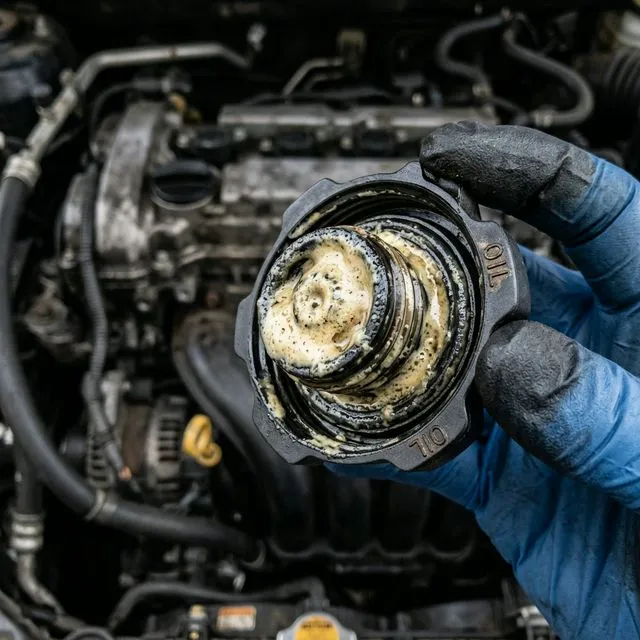
| Milky or emulsified material | Moisture may be present, but the cause is not proven | Check applicability and cooling-system evidence; diagnose persistent or widespread emulsion |
| Metal-like debris or abnormal texture | Possible contamination; severity cannot be judged from color alone | Do not continue routine use without qualified inspection |
| Dark oil with normal level and no warning | Color alone does not measure remaining oil life | Follow the schedule and monitor other evidence |
The dipstick is useful—but not a laboratory
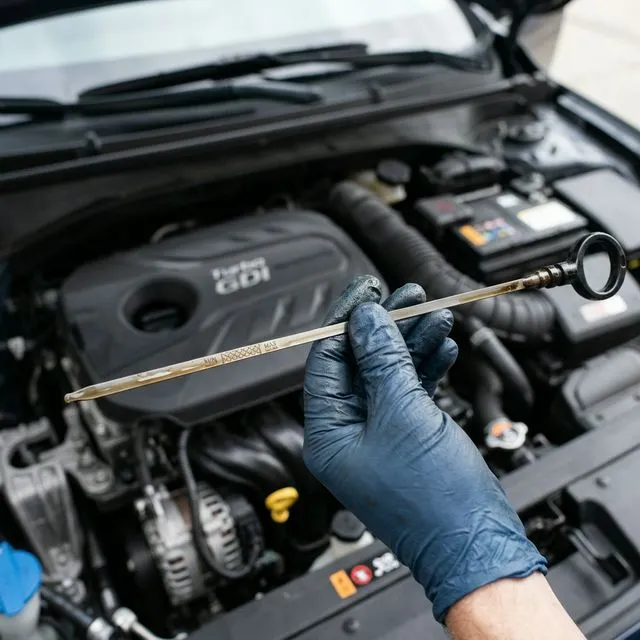
The dipstick can reveal level and obvious change. It cannot measure viscosity, oxidation, fuel dilution, additive condition, or whether an oil still meets its specification. Those questions require controlled testing or oil analysis.
Darkening can be normal. Haze also does not prove that two oils suffered “additive dropout.” Different formulations and contaminants can change appearance, so a homemade clarity test is not a safe diagnostic method.
Milky residue needs context
Toyota T-SB-0104-21 Rev2 documents a specific cold-weather emulsion condition for named Toyota and Lexus vehicles. The bulletin requires checking exact applicability and whether coolant loss or a cooling-system leak is present. That is a useful diagnostic model: do not jump from one patch of residue under a cap to a universal head-gasket or “hybrid oil failure” conclusion.
Persistent emulsion through the oil, coolant loss, overheating, or abnormal running deserves prompt professional diagnosis.
Noise, odor, and fuel economy are not oil-only diagnoses
Tapping, knocking, hesitation, a fuel smell, or reduced fuel economy can have many causes. API oil categories include tests related to low-speed pre-ignition protection, but a driver cannot diagnose LSPI—or blame oil chemistry—from bucking or one knock event alone.
Similarly, a fuel odor may justify checking for dilution or a fuel-system fault, but smell cannot quantify dilution. A burning odor may come from oil leaking onto a hot component rather than from degraded oil in the sump. Use the oil-smell diagnosis guide to separate those paths.
Frequently Asked Questions
Can oil color tell me when to change it?
No. Follow the maintenance schedule or oil-life system. Use color only as one observation alongside level, texture, warnings, and vehicle-specific guidance.
Which warning means I should stop the engine?
Treat an oil-pressure warning as urgent. Stop safely, turn the engine off, and follow the manual before deciding whether it can be restarted.
Does milky residue always mean coolant is in the oil?
No. Moisture can create residue in some operating conditions. Coolant loss, widespread emulsion, overheating, or applicable technical guidance changes the risk and should be diagnosed.
Can the wrong specification cause a problem?
Yes, which is why the complete viscosity, API or ACEA category, and required OEM specification must match. Symptoms alone usually cannot prove that mismatch caused a fault.
Sources
- Ford Motor Company, Oil Pressure Warning Lamp, shutdown, level-check, and sufficient-level instructions. Accessed July 27, 2026.
- Toyota Motor Sales USA, T-SB-0104-21 Rev2, pages 1–4, exact applicability, cold-weather emulsion condition, and cooling-system leak exclusion. Accessed July 27, 2026.
- American Petroleum Institute, Motor Oil Guide, gasoline service-category and certification-mark guidance. Accessed July 27, 2026.
- Chevron Lubricants, Interpreting Oil Analysis, viscosity, oxidation, and contamination measurements used in oil analysis. Accessed July 27, 2026.
Read Next
- What Engine Oil Color Really Means
- Low Engine Oil Pressure: What to Do
- Car Oil Smell: Causes and Urgency
| *Last Updated: July 2026 | 6-minute read* |