
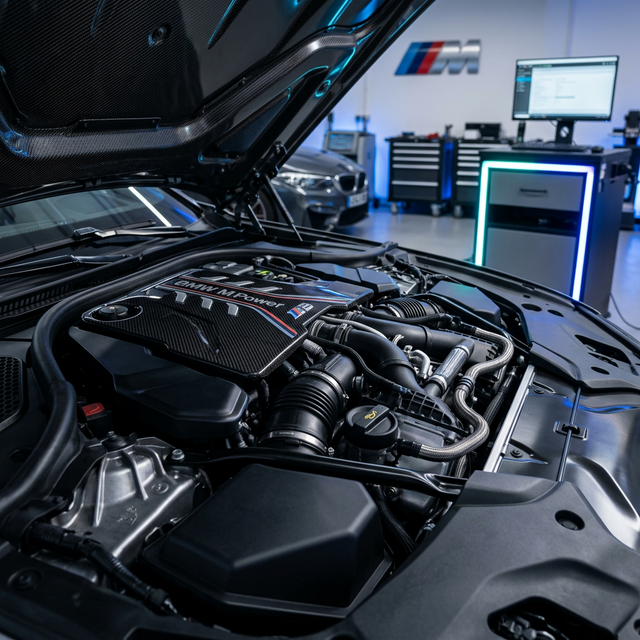
Most BMW owners walk into an auto parts store, scan the shelf for something that says “BMW approved,” and hope for the best. That’s not how this works. BMW’s Longlife (LL) oil approval system is an engineering specification — and matching the wrong one to your engine doesn’t just waste money. It degrades performance, accelerates carbon buildup, and in hybrid models, can accelerate internal corrosion between oil changes.
Here’s how to read BMW’s oil spec system correctly, what’s changed in the US market, and which oil is the right match for your specific engine.
Watch: How to Choose Best Oil for BMW
Grabbing any "BMW-approved" bottle off the shelf is a gamble. This video decodes the four critical checks you must make to match the right BMW Longlife spec to your engine and avoid long-term damage.
The BMW Longlife Approval System — What It Actually Means
BMW doesn’t endorse brands. They approve formulations. When a bottle says “BMW LL-17 FE+ approved,” that oil has passed BMW’s own laboratory tests for viscosity stability, oxidation resistance, fuel economy impact, and additive chemistry — under the conditions that specific engine family operates in.
The approvals aren’t interchangeable. An LL-01 oil and an LL-17 FE+ oil have meaningfully different additive chemistry. Using LL-01 in a B48 engine (which requires LL-17 FE+) doesn’t give you extra protection. It gives you the wrong protection — higher SAPS content that can harm the engine’s particulate filter and doesn’t meet the friction reduction targets BMW calibrated the valve train around.
The spec on your oil cap is a chemical requirement. Treat it as one.
Why LL-04 Is Now a Smart Choice for US Turbo Engines
For years, the guidance in US BMW forums was clear: avoid LL-04 in American gasoline engines. That advice was correct — at the time.
LL-04 is a low-SAPS (Sulfated Ash, Phosphorus, and Sulfur) formulation. In the early 2000s, US gasoline had high sulfur content that would prematurely break down the additive package in low-SAPS oils. The conventional wisdom pointed US owners toward LL-01, which had a more robust detergent package.
That changed in 2017. US fuel sulfur levels dropped below European levels following updated EPA regulations. The original justification for avoiding LL-04 stateside no longer applies.
Here’s why this matters for modern turbo engines: direct injection engines like the N54, N55, and B58 have a chronic intake valve carbon problem. In a port injection engine, fuel spray constantly washes the intake valves clean. In a direct injection engine, no fuel ever touches the intake side — so oil vapor from the PCV system deposits carbon directly onto the valves, unreachable by combustion.
Low-SAPS LL-04 oil produces less sulfated ash during combustion. Less ash means slower carbon accumulation on the intake valves — a real, measurable difference over 50,000+ miles. For US owners running modern turbo gasoline engines, LL-04 is now the technically superior choice, not a compromise.
The Hybrid Cold-Start Problem — Why LL-22 Exists
If you drive a BMW plug-in hybrid — the X5 xDrive50e, 330e, 530e, or similar — your engine oil faces a degradation pattern that standard oils weren’t designed for.
In a conventional car, the engine runs continuously. Oil reaches full operating temperature, thermal cycling burns off condensation and fuel byproducts, and the additive package does its job under predictable load.
In a hybrid, the ICE starts and stops constantly. On a short urban commute where the battery handles most of the work, the engine may never reach full operating temperature. When that happens:
- Fuel dilution occurs: unburned fuel washes down the cylinder walls and mixes directly into the oil sump
- Water contamination builds up: condensation that would normally evaporate at operating temperature stays suspended in the oil
- The oil’s Total Base Number (TBN) — its ability to neutralize acids — depletes faster than the mileage suggests
The result is oil that looks fine on the dipstick but has already lost a significant portion of its protective capacity. This isn’t theoretical. It’s documented in fleet data from hybrid-heavy European markets.
BMW’s LL-17 FE+ (required for B-series engines including the B48 and B58) and the newer LL-22 FE++ address this with enhanced oxidation stability, higher TBN reserve, and friction modifiers engineered for instant cold-start protection — because in a hybrid, every engine start is effectively a cold start.
If you own a BMW hybrid and you’re running a standard LL-01 or LL-04 oil because “it has BMW approval” — you’re using the wrong spec for your duty cycle.
BMW LL Specifications: Quick-Reference Guide
| Specification | Viscosity | Key Characteristic | Best Use Case |
|---|---|---|---|
| LL-01 | 5W-30 / 5W-40 | High SAPS / High Detergency | Older, high-mileage gasoline engines without particulate filters |
| LL-04 | 5W-30 | Low SAPS / ZDDP-optimised | Modern turbos and diesels; DPF protection; reduces intake valve carbon |
| LL-12 FE | 0W-30 | Fuel Economy / European | Specific 3-, 4-, and 6-cylinder diesels and gas engines from 2012 (Europe-primary) |
| LL-17 FE+ | 0W-20 | Ultra-Low Friction | Mandatory for B-series engines (B46, B48, B58); maximum efficiency and turbo protection |
| LL-22 FE++ | 0W-20 | Hybrid-Optimised | PHEV models with frequent cold-start cycles; elevated TBN for acid neutralisation |
Check your oil filler cap or owner’s manual for the exact spec. If the cap says LL-17 FE+, nothing else is an acceptable substitution — not “close enough,” not a higher-grade conventional.
Oil Choices for Specific Use Cases
The approval list narrows your options. But within any approved spec, some formulations outperform others in specific conditions.
B58 with performance driving: Liqui Moly Top Tec 6600 (0W-20) carries LL-17 FE+ approval and is notable for maintaining oil film resistance under sustained high load — relevant if you track the car or consistently drive at the upper range of the rev band. Most 0W-20 oils thin out more aggressively at elevated temperatures.
High-output M engines (S54, S65, S85): These engines specify 10W-60. Castrol EDGE 10W-60 remains the reference point here. The viscosity range exists specifically because M engines run higher bearing clearances and operating temperatures — using a thinner oil to “save fuel” in an M3 or M5 is an engine-damage decision, not a frugal one.
High-mileage LL-01 engines: Older BMW six-cylinders (M54, M52) that have accumulated 100,000+ miles often benefit from a 5W-40 LL-01 formulation over 5W-30. Slightly higher viscosity helps maintain oil pressure as bearing clearances widen with wear. Eurol Syndura 5W-40 is a less-marketed but technically solid option in this category. Read our high-mileage engine oil guide.
The CBS Interval Problem — Why 15,000 Miles Is Often Too Long
BMW’s Condition Based Service (CBS) system is a sensor-driven algorithm that calculates the maximum allowable oil change interval based on driving pattern, temperature cycles, and fuel consumption data. Under ideal highway driving conditions, it can stretch to 15,000 miles.
The word to note is maximum. CBS calculates when oil has reached the outer edge of its usable life. It doesn’t account for risk tolerance or the cumulative effect of repeated short-trip degradation.
If your typical driving is urban — short trips, frequent cold starts, stop-and-go traffic — your oil is degrading faster than the mileage accumulates. Fuel dilution from incomplete combustion cycles adds up. The additive package depletes. CBS doesn’t see any of that directly.
For turbocharged or hybrid BMW owners, a 5,000-mile (8,000 km) interval is a defensible standard regardless of what CBS displays. Turbo bearings are oil-fed, and they run hot after shutdown — they’re particularly sensitive to oxidized, depleted oil. Hybrid owners face the fuel dilution and cold-start issues outlined above.
You’re not overriding BMW’s engineering by changing oil early. You’re making a risk-adjusted decision about how aggressively to use that maximum interval.
FAQ
Can I use LL-04 in my N55 BMW in the United States? Yes. Since US gasoline sulfur levels dropped below European levels after 2017, LL-04 is a sound choice for N55 and similar turbo direct injection engines. Its low-SAPS formulation actually helps reduce intake valve carbon buildup — a known issue in DI engines.
What happens if I use LL-01 oil in a B48 or B58 engine that requires LL-17 FE+? LL-01’s higher SAPS content can accelerate particulate filter loading and doesn’t meet the friction reduction targets BMW built into the B-series valve train. You likely won’t notice immediate damage, but you’re not getting the protection those engines were engineered for — and you may see elevated carbon deposits over time.
My BMW hybrid shows 10,000 miles left on CBS. Should I wait? For hybrid owners, CBS intervals tend to overestimate oil health because the sensor model underweights the effect of frequent cold starts and fuel dilution. A 5,000-mile interval is a reasonable standard for PHEV models regardless of CBS remaining life.
Is there a difference between LL-17 FE+ and LL-22 FE++? Yes. LL-22 FE++ is specifically formulated for plug-in hybrid duty cycles — it has higher oxidation resistance and a stronger TBN reserve to handle the acid accumulation from frequent cold starts. LL-17 FE+ is the standard for B-series engines. If your BMW is a PHEV, check whether your specific model lists LL-22 as the preferred specification.
Does it matter which brand I buy, as long as it has BMW LL approval? Approval means the oil passed BMW’s minimum performance thresholds. Within an approved spec, formulation quality, base oil type (Group III vs. Group IV PAO), and additive package do vary. For everyday driving, any approved oil from a major manufacturer is adequate. For high-performance or high-stress applications, it’s worth checking third-party test data (like the NOACK volatility test or CCS cold-cranking results) rather than relying on approval alone.
Can I mix LL-17 FE+ with LL-01 for a top-up? A small top-up (less than 0.5L) is unlikely to cause immediate harm, but mixing specs reduces the effectiveness of both formulations. If you need to top up between changes and don’t have the correct spec available, do it minimally and change the oil at the next available interval.
How do I know which BMW LL spec my engine actually needs? Check the oil filler cap first — BMW prints the required spec directly on it. If the cap is missing or unreadable, the owner’s manual lists it under the lubrication specification section. You can also use OilFinderPro’s oil selector tool to confirm by entering your VIN or engine code.
The Right Oil Is a Specification Match, Not a Brand Decision
BMW’s approval system does the heavy lifting. Your job is to match the correct LL spec to your engine, then choose a quality formulation within that spec. Don’t go below (using LL-01 in a B58). Don’t assume “higher grade” means better (LL-01 in a PHEV is worse than LL-22, not safer).
If you’re unsure where your engine lands, use the OilFinderPro oil selector — enter your model and engine code, and it returns the correct specification with approved product options.
| *Last Updated: March 2026 | 8-minute read* |
Read next: