Engine Oil Overfill: What Happens and How to Fix It Before You Wreck Your Engine
Most people know running low on oil is bad. Fewer people know that too much oil can be just as destructive — and it can happen faster.
A quick-lube shop puts in 6 quarts when your engine calls for 4.5. Or you do your own oil change and lose count. Either way, you drive off. The engine sounds fine. And then, sometimes within hours, the damage is already done.
Here’s what’s actually happening inside your engine when it’s overfilled — and what you need to do about it.
The Myth That Engine Size Determines Oil Capacity
Before getting into what overfill does, it’s worth clearing up how oil capacity actually works. Because a lot of overfill mistakes start here.
Engine displacement doesn’t determine how much oil your engine holds. Not directly.
A 6.8L Ford V10 takes around 7 quarts. A 1.2L Mitsubishi Mirage takes 3.2 quarts. Per liter of displacement, the tiny 3-cylinder needs more than twice as much oil as the massive V10. Try to guess your capacity by engine size and you’ll be wrong more often than you’d expect.
The actual capacity depends on bearing surface area, oiling system design (wet sump vs. dry sump), whether the engine runs a turbo or supercharger, whether there’s an external oil cooler, and a handful of other engineering factors most owners never think about. The only reliable source is the “refill with filter” spec in your owner’s manual — or a verified database. Find your exact engine oil capacity using the OilFinderPro tool
That’s how overfill happens. Someone assumes a V6 takes roughly what their old 4-cylinder took and pours accordingly.
What Overfilled Oil Actually Does to Your Engine
The crankshaft spins inside your engine at thousands of RPM. It sits above the oil pan, separated from the oil by design — because that separation matters.
When the oil level is too high, the crankshaft counterweights start hitting the oil. At 2,000 RPM, that’s like someone whipping cream with an industrial mixer. The oil gets churned into foam.
Foam doesn’t lubricate.
Engine bearings rely on what’s called a hydrodynamic wedge — a thin, continuous film of liquid oil between the moving metal surfaces. The moment that film becomes compressible (because it’s full of air bubbles), it collapses under load. Metal touches metal. Bearings start to fail.
That’s where it starts. Here’s where it goes:
The oil pump starts pulling foam. Pumps are designed to move liquid, not air. When aerated oil hits the pump, the bubbles collapse violently — a process called cavitation — which erodes the pump internals. Oil pressure drops. You’ll sometimes hear a whining sound. That’s the pump struggling.
Heat stops moving out of the engine. Liquid oil carries heat away from the pistons and block. Foam insulates. Hotspots develop. Additive packages break down faster. You’re burning through oil life in a fraction of the normal time.
Crankcase pressure spikes. The oil is displacing the air volume the crankcase needs. Pistons moving up and down pressurize an already over-full space. That pressure finds the weakest seals — usually the front and rear main crankshaft seals — and blows them out. Oil starts dripping under the car.
Oil gets into the combustion chamber. Either through the piston rings or through the PCV system, excess oil gets burned. Blue or white smoke from the tailpipe is the giveaway. Spark plugs foul. Catalytic converter gets contaminated. If enough liquid oil fills a cylinder — which does happen in serious overfill cases — you get hydrolock. The piston hits incompressible fluid and stops dead. Connecting rods snap. Engines crack.
That last scenario sounds extreme. It is. But a 4-cylinder engine that holds 4 quarts and gets 8 poured into it? That’s not a hypothetical.
How Much Is Too Much
There’s a buffer zone. Engineers build it in.
| Overfill Amount | Risk Level | What to Do |
|---|---|---|
| Under 0.5 qt (500ml) | Low | Monitor; engine may burn off excess |
| 0.5 – 1 qt | Moderate | Drain soon; don’t ignore it |
| 1+ quart | High | Don’t drive. Drain immediately. |
| 2+ quarts | Critical | Stop the engine now. Serious damage may already be occurring. |
The 1-quart threshold is where most mechanics draw the hard line — but on a smaller engine, even slightly less can be a problem. A 1-quart overfill on a 4-quart engine is a 25% increase in fluid volume. That’s not a minor variance.
How to Tell If Your Engine Is Overfilled
Don’t rely on the oil life indicator on your dashboard. It tracks time and mileage, not actual fluid level.
Check it yourself — but do it right. Park on flat, level ground. Run the engine for 5–10 minutes, then shut it off and wait a few minutes for the oil to drain back down from the upper engine. Pull the dipstick, wipe it completely clean, reinsert it fully, then pull it out again.
If the oil sits more than a quarter-inch above the MAX line, you’ve got a problem.
Also look at the oil itself. If it looks frothy or bubbly — like a latte instead of clean oil — active aeration is already happening. That engine should not be driven.
Other warning signs:
- Blue or white exhaust smoke
- Burning oil smell from the engine bay
- Ticking, knocking, or whining from the engine
- Oil drips or leaks you didn’t have before
How to Remove Excess Oil Without Making It Worse
Two methods. One is clearly better for DIYers.
Vacuum extraction (recommended): Get a manual or electric oil extractor — a small pump with a flexible tube. Feed the tube down through the dipstick channel until it touches the bottom of the oil pan. Pump out oil in small increments, checking the dipstick between pulls. You can extract a few ounces at a time and stop exactly at the right level. Clean, precise, no jacking the car.
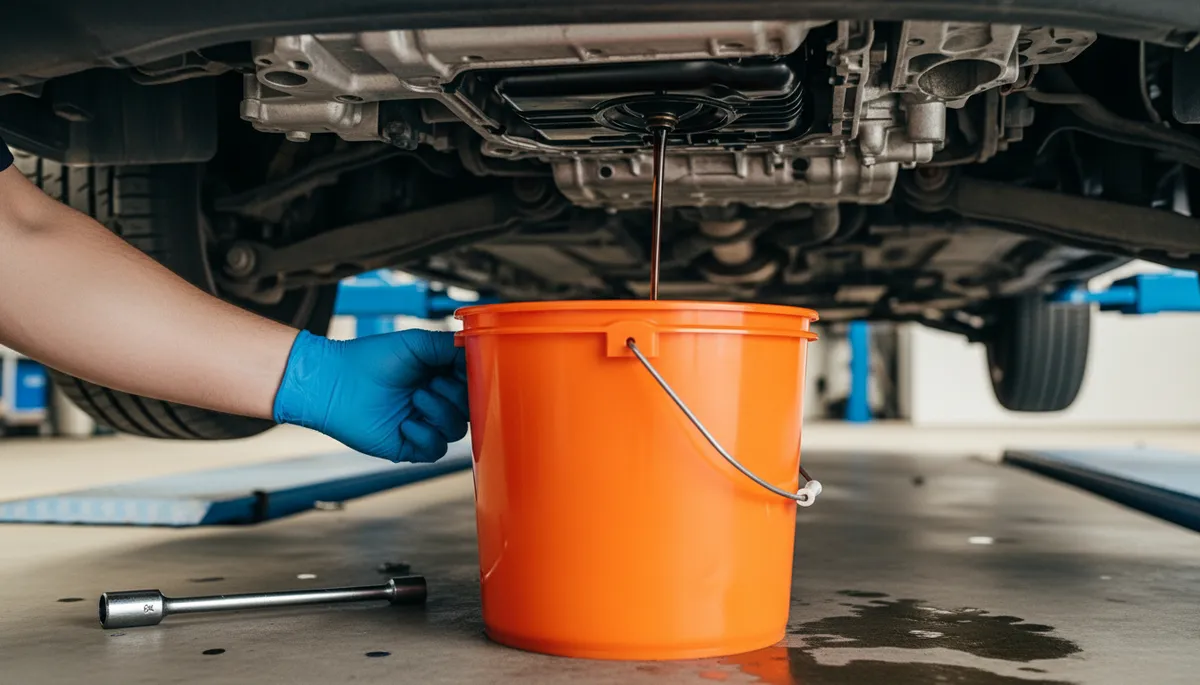
Drain plug method: This works but requires more care. Jack the car safely onto stands. Locate the drain plug on the oil pan. Loosen it slowly — just enough to let oil weep out, not gush. Don’t let go of the plug. Once you’ve drained a small amount, retighten, lower the car, and check the dipstick. Repeat if needed.
One thing to avoid: removing the oil filter to drain excess. Modern cartridge filters don’t hold enough volume to matter, and messing with the filter seal when you don’t need to risks creating a new leak.
If a Shop Did This to Your Car
Quick-lube operations run fast. That’s the model. And sometimes fast means someone pumps 8 quarts into a 4-quart engine and doesn’t catch it before handing you the keys.
If that happens, there are things worth knowing.
First: the Magnuson-Moss Warranty Act means a dealership cannot void your factory warranty just because an independent shop or you yourself performed maintenance. If the overfill happened at a shop and they’re trying to blame it on your warranty coverage, that’s not a legal position they can hold without proving the specific part caused the failure. Burden of proof is on them.
Second: if the shop’s mistake destroyed your engine, take photos of the dipstick level before anything is touched. Get the vehicle towed — don’t drive it — to an independent mechanic for a written diagnostic that identifies the cause. Keep every receipt and work order.
Third: if the damage is severe and clearly the shop’s fault, there’s a legal doctrine called res ipsa loquitur — “the thing speaks for itself.” An engine hydrolocking shortly after an oil change, with the dipstick showing double the correct level, is exactly the kind of event this doctrine covers. It shifts the burden of proof onto the shop to show they weren’t negligent. That gives you real leverage in a dispute or small claims court.
Dispute the charge with your credit card company within 60 days if the shop refuses to make it right. Your secondary diagnostic report is your evidence.
FAQ
Can overfilling oil damage my engine after just a short drive? Yes. If the overfill is severe — 1 quart or more — even a few miles is enough to cause foaming and bearing damage. The damage is often invisible until it compounds into something more serious. Don’t wait.
What does foamy oil on the dipstick mean? It means the crankshaft is already making contact with excess oil and churning it into an aerated foam. Foamy oil has lost its ability to lubricate properly. The vehicle should not be driven until the excess is removed.
My oil is slightly above MAX — do I need to drain it? If it’s less than a quarter-inch over, monitor it. Many engines will burn off a small excess over normal operation. If it’s more than that, or if the engine is small (4-cylinder), it’s worth extracting the excess now rather than hoping for the best.
Will overfill damage show up on my dashboard warning lights? Not reliably, and usually not early enough. The oil pressure light only comes on when pressure has already dropped significantly — by that point, damage may be underway. The oil life monitor tracks time and mileage, not fluid level. Dipstick is the only accurate check.
Can a shop be held liable for overfilling my oil? Yes. Overfilling is a basic technician error that falls under negligence — they accepted payment for a service and performed it incorrectly. Document the dipstick level, get an independent diagnostic report, and keep all paperwork. If the damage is clear-cut, you have strong grounds for a claim.
Does engine oil capacity change with oil type (conventional vs. synthetic)? No. Capacity is determined by the engine’s physical design, not the oil type. The spec in your owner’s manual applies regardless of whether you use conventional, full synthetic, or a blend.
How do I find the exact oil capacity for my specific engine? Your owner’s manual is the starting point. For older vehicles or if you’ve swapped engines, a verified spec database is more reliable than general forum advice. Use the OilFinderPro database to look up your exact capacity by year, make, model, and engine.
Read Next
- Complete oil change interval guide — how often should you actually change your oil
- Guide to choosing oil viscosity for your engine — what 5W-30 vs 5W-40 really means
| *Last Updated: April 2026 | 8-minute read* |
Written by the OilFinderPro Team — helping drivers find the right oil spec for their exact engine.