
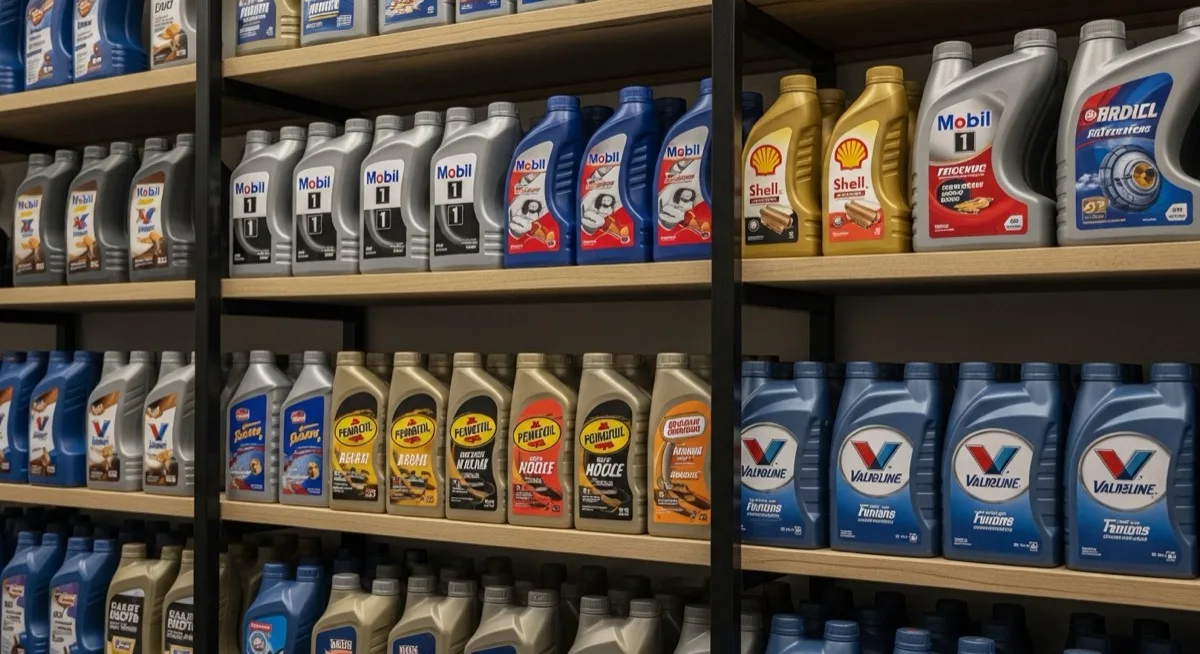
There is no evidence-based “best engine oil brand” for every car. Mobil 1, Pennzoil, Castrol, Valvoline, AMSOIL, and other established brands each sell multiple formulas. The useful comparison is exact product versus exact vehicle requirement.
For most drivers, the best product is the one that matches the required viscosity, industry category, and manufacturer specification—with current documentation you can verify.
The 2026 engine oil brand comparison scorecard
Use this scorecard on any product. A brand name cannot compensate for a failed requirement.
| Check | Pass | Caution | Fail |
|---|---|---|---|
| SAE viscosity | Exact grade required by the manual | Alternate grade is allowed only under stated conditions | Different grade with no documented permission |
| API/ILSAC or ACEA category | Exact required category or documented compatible category | Compatibility is assumed from marketing copy | Wrong gasoline/diesel track or wrong ACEA category |
| Manufacturer specification | Exact current approval or claim required by the manual | Wording is unclear or applies to another grade | Required code is absent |
| Product identity | Label and data sheet match product, grade, and market | Retail listing uses generic images | Evidence is stale or for another product |
| Service interval | Vehicle schedule or oil-life system controls | Product markets an extended interval | Product claim replaces the vehicle schedule |
| Availability | Same verified product is easy to obtain for top-ups | Formula or label varies by market | Substitute would be required without verification |
If a product fails the first three rows, stop comparing price, base oil, or marketing features.
How the major brands should be compared
If your shortlist includes Mobil 1, Pennzoil, Castrol, Valvoline, or AMSOIL, apply the same questions to each:
- Which exact product line and viscosity is this?
- What API, ILSAC, or ACEA category appears on the current label?
- Which OEM specifications are approved, and which are only marketer recommendations?
- Is the data sheet for the country where the oil will be purchased?
- Does the vehicle manufacturer—not the oil advertisement—permit the proposed service interval?
This makes the comparison fair. “Castrol EDGE,” “Mobil 1,” or another family name can cover several grades and specifications, so family-level claims are not enough.
Licensed, approved, and self-certified are not the same thing
API marks
API’s Motor Oil Guide explains the certification marks and service categories used on licensed oils. For a US-market application, verify the exact mark and category that the vehicle requires.
ACEA claims
ACEA’s general requirements state that ACEA sequence claims are made on a self-certification basis. ACEA does not turn every product carrying an ACEA claim into an OEM-approved oil. The product must still match the required ACEA class and category, and any separate manufacturer approval.
Manufacturer approvals
An OEM approval is tied to a named specification and product evidence. Wording such as “meets requirements,” “recommended for,” or “suitable for” can represent an oil marketer’s claim rather than a current approval.
Read OEM-approved oil versus “meets requirements” before using those phrases as equivalents.
Why the old lab-ranking table was removed
Numbers such as NOACK volatility, TBN, pour point, and viscosity can be useful when they come from current technical data sheets or controlled testing. They do not create a trustworthy brand ranking when the samples differ by viscosity, formulation, market, test source, or date.
A lower reported volatility on one 5W-30 does not prove that the brand is best across its whole range. A higher fresh-oil TBN does not authorize a longer interval for your car. Used-oil analysis also depends on the engine, duty cycle, fuel, interval, sampling, and laboratory method.
For ranking content, comparable methods and exact product identity are prerequisites. Without them, a clean-looking table creates false precision.
Product data sheet examples
Official product pages show why product-level verification matters:
- Mobil’s current page for Mobil 1 FS 5W-30 lists named manufacturer approvals and tells drivers to check the owner’s manual for the required grade and specifications.
- Pennzoil publishes grade-specific product data sheets, such as the sheet for Pennzoil Full Synthetic 5W-30.
- Castrol’s product finder asks for vehicle make, model, and year rather than presenting one Castrol oil for every vehicle.
Those sources document only those exact products or tools. Do not transfer their approvals or recommendations to another viscosity, product line, or market.
Is full synthetic the deciding factor?
No. Formulation type comes after specification fit.
If the manual requires full synthetic, use it. If multiple formulation types satisfy every requirement, compare the documented benefits and your operating conditions. Never choose a synthetic oil with the wrong specification over a conventional or synthetic-blend product that correctly meets the manual.
See synthetic versus conventional engine oil for that decision.
What about high-mileage and extended-performance oils?
These labels describe product positioning, not universal vehicle requirements.
For a high-mileage formula, confirm that it still matches every grade and specification requirement. For an extended-performance formula, keep following the vehicle’s maintenance schedule or oil-life monitor unless the manufacturer explicitly permits a different interval.
An oil company’s mileage claim is not a universal drain interval.
A practical brand-shopping workflow
- Copy the exact requirements from the owner manual.
- Use the best-engine-oil selection checklist to identify mandatory fields.
- Shortlist exact products—not brands—that match those fields.
- Open the current label or technical data sheet for each exact grade.
- Verify approval wording and market.
- Choose among the passing products using price, availability, and preference.
- Keep a record or photo so a future top-up uses the same verified product.
If you do not have the requirement yet, start with OilFinderPro’s vehicle specifications lookup and verify the result against current manufacturer information.
Frequently asked questions
Is Mobil 1 better than Castrol or Pennzoil?
Not as a brand-wide rule. Compare the exact products against the exact vehicle requirement. One may have the approval you need while another product from the same brand does not.
Is expensive engine oil always better?
Price is not evidence of application fit. First match viscosity, industry category, and manufacturer specification; then compare cost among products that pass.
Can I switch between oil brands?
The replacement must satisfy the vehicle’s requirements. Brand is secondary. For emergency top-ups and mixed fills, see can you mix engine oils?.
Which brand lasts the longest?
Do not set the vehicle’s change interval from a brand slogan. Follow the manufacturer schedule or oil-life system and the documented severe-service rules.
Sources
- American Petroleum Institute, Motor Oil Guide, API certification marks and gasoline/diesel category guidance. Accessed July 27, 2026.
- ACEA, ACEA Oil Sequences 2023—General Requirements, page 3, ACEA claim process and category nomenclature. Accessed July 27, 2026.
- Mobil, Mobil 1 FS 5W-30 product data, Applications and Specifications and Approvals sections. Accessed July 27, 2026.
- Pennzoil, Full Synthetic Motor Oil SAE 5W-30 product data sheet, product identification and specification table. Accessed July 27, 2026.
- Castrol USA, Product Finder, vehicle-specific selection fields and recommendation scope. Accessed July 27, 2026.
Read Next
- Best Engine Oil: Four Checks That Matter
- Synthetic vs. Conventional Engine Oil
- OEM Approved vs. “Meets Requirements” Oil
Last Updated: July 2026