

You’re standing over your open hood, staring at a dipstick, and thinking: “It looks okay, right?”
Wrong. Most drivers think dark oil is the ultimate enemy. It isn’t. In a modern Gasoline Direct Injection (GDI) engine, the oil is a structural component that can fail chemically long before it ever turns black. If you’re waiting for the oil to “look dirty” before you change it, you’re already playing a dangerous game with your bearings.
Common bad engine oil symptoms usually start with a slight metallic tapping at idle, a drop in your fuel economy, or a faint scent of burning toast. If you actually see the oil pressure light flicker, you aren’t looking at a “symptom”—you’re looking at an autopsy. For owners of modern TGDI or Hybrid vehicles, the real signs of failure are often completely invisible to the naked eye.
Watch: 3-Minute Diagnostic Oil Guide
Short on time? This video walks through the 'silent' symptoms of oil failure in GDI and Hybrid engines, including how to spot fuel dilution and why your maintenance light might be lying to you.
Your Dipstick is a Terrible Diagnostic Tool
We’ve been told for decades that dark oil equals bad oil. That’s a total myth. Dark oil usually just means the detergents are doing their job, keeping soot from turning into sludge. The real indicator of a crisis is viscosity and chemistry.
Modern GDI engines suffer from a silent killer called fuel dilution. Unburnt gasoline washes past the piston rings and thins your oil out. Here is the kicker: your dipstick might show the oil level is rising or staying perfectly full. You haven’t discovered a way to create oil; you’ve discovered that your lubricant is being replaced by solvent. If your oil smells like a gas station, it’s done. Change it immediately.
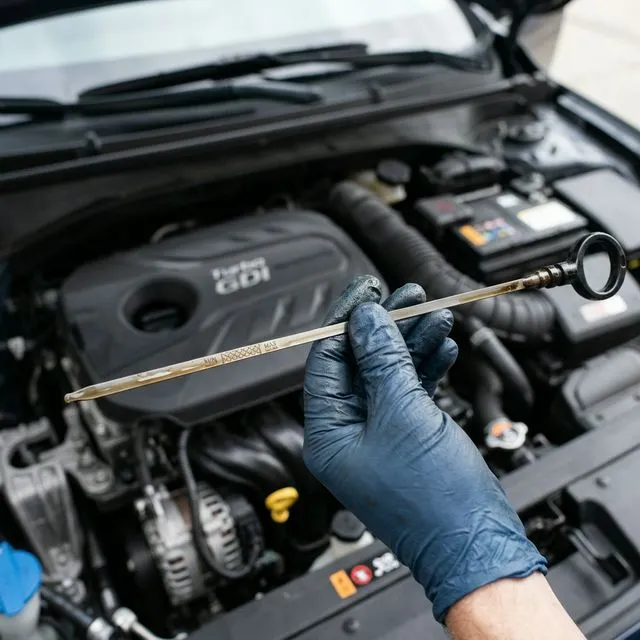
The TGDI Trap: When Oil Makes Your Engine Explode
If you drive a turbocharged GDI car, “bad oil” has a symptom you won’t find in a 90s Honda manual: Low-Speed Pre-Ignition (LSPI).
You’ll hear this as a heavy, random “super-knock” when you accelerate from a stop. It’s not just a bad sound—it’s the sound of your pistons cracking. This happens when oil droplets mix with fuel and explode before the spark plug even fires.
- The Hard Truth: This failure is often caused by the chemistry of the oil. High calcium-based detergents in older oil specs actually trigger these explosions.
- The Symptom: Stuttering or “bucking” under light acceleration at low speeds.
If your car feels like it’s tripping over itself when you pull away from a light, your oil chemistry has likely shifted or you’re using an outdated spec like API SN instead of the required SP.
The Hybrid Paradox: Why Short Trips are Toxic
Hybrids are supposed to be the “clean” choice, but they are brutal on motor oil. Because the engine cycles on and off constantly, it rarely stays hot enough to evaporate condensation.
This leads to a specific symptom: milky residue under the oil cap or a “thinner” feel to the liquid. Without sustained heat, moisture and raw fuel stay in the sump, creating a chemical soup that corrodes internal parts while you’re driving in electric mode. Recent lab data shows that hybrids often suffer from viscosity loss that you can’t see, but you’ll definitely feel when the engine finally starts and sounds like a bag of marbles.
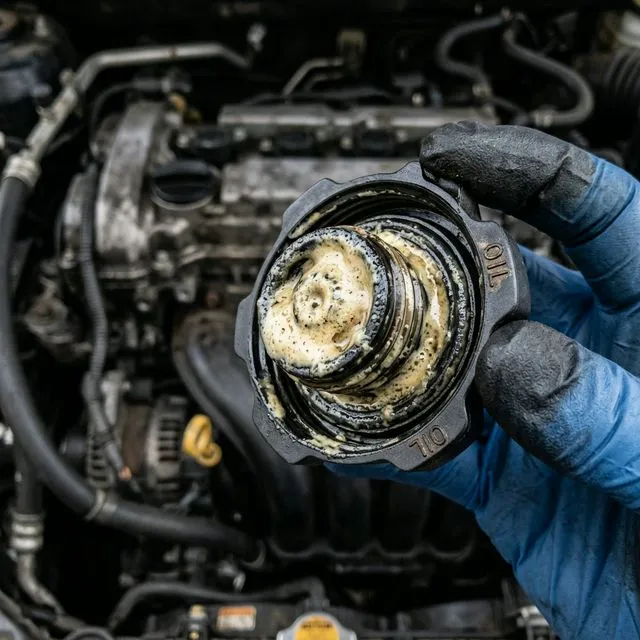
The Clarity Test: A 30-Second Life Saver
I see people “topping off” their 0W-20 with a quart of 10W-40 because it was the only thing at the gas station. That is a massive mistake. While they might mix, you’re often triggering additive dropout.
When you mix different brands or weights, the Zinc (ZDDP) and detergents can literally fall out of the liquid. If the oil on your dipstick looks slightly hazy or lacks that clear, translucent “honey” look, you’ve likely triggered a chemical reaction that is no longer protecting your engine.
Case Study Snippet: I recently saw a 2018 Kia Soul owner who was burning a quart every 1,000 miles. The dealer called it “normal.” It wasn’t. The oil had thinned out so much from carbon packing that the rings got stuck. By the time they noticed the “burning smell,” the engine was already a paperweight.
The Bottom Line
Don’t wait for a light on the dashboard. In 2026, your ears and your fuel economy gauge are better tools than your eyes. If the engine sounds “tappy” on a cold start or your MPG drops by 10% for no reason, the oil has checked out.
The fastest way to avoid these bad engine oil symptoms is to stop guessing. Pop your VIN into oilfinderpro.com and get the exact spec your engine needs to actually survive.
Read Next:
| *Last Updated: March 2026 | 8-minute read* |