Two weeks after an oil change, you pull out the dipstick. Nearly dry. No puddle under the car, no warning light — just gone.
This happens more than most people realize. And the frustrating part? Dealers often tell you it’s normal.
It isn’t. Here’s what’s actually going on.
Watch: 2-Minute 24-Second Car Is Burning Oil? The Fix Guide Video
In this video, we break down the exact order you should follow to stop oil burning without jumping straight to a mechanical rebuild. We cover why the $20 PCV valve is the first thing you should check and why switching to a much thicker oil is a dangerous mistake.
Why Your Car Burns Oil
Oil doesn’t disappear on its own. It’s getting into the combustion chamber, burning with the fuel, and leaving through the exhaust. The question is how it’s getting there.
Three ways this happens:
- Piston rings that are worn or stuck can’t seal the cylinder wall. Oil slips past them on every stroke.
- Valve stem seals that have hardened or cracked let oil seep down the valve stems while the car sits parked. Start the engine and it burns off immediately.
- A failed PCV valve turns what should be a controlled vent into a vacuum line that actively pulls oil into your intake.
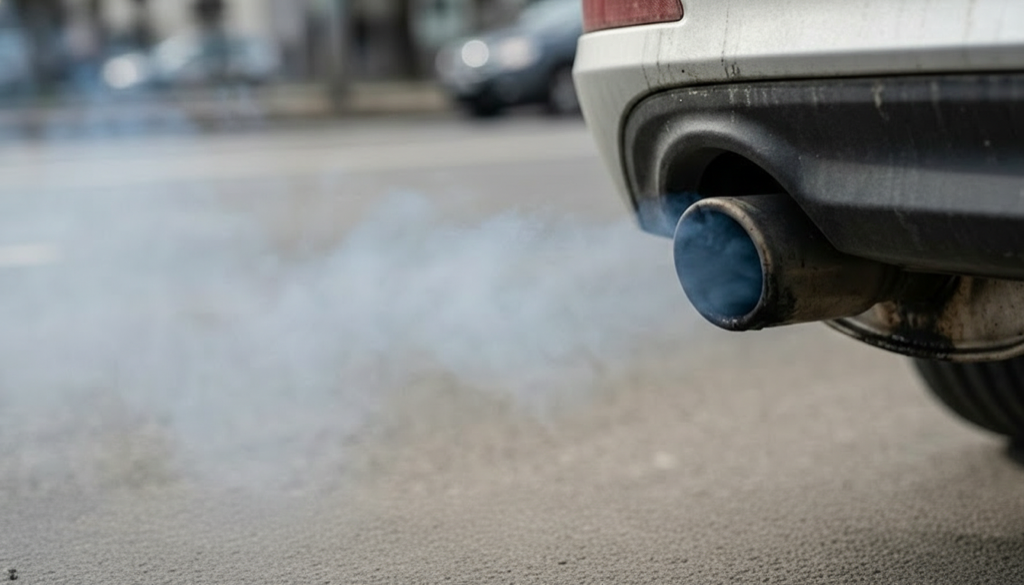
Each one has a different symptom. Blue smoke when you first start the car — especially after it’s been sitting overnight — that’s valve seals. Oil just quietly disappearing with no smoke? Rings or PCV. Knowing which one you’re dealing with matters, because the fixes are very different.
“It’s Within Spec” — What Dealers Actually Mean by That
Hyundai, Kia, BMW — they all have TSBs (Technical Service Bulletins) that say oil consumption only becomes a “problem” when you’re losing more than a quart every 750 to 1,000 miles.
That threshold used to be unthinkable. An engine drinking a quart between oil changes was headed for a rebuild, not a shrug.
So what changed? Fuel economy regulations. To hit CAFE standards, engineers started using low-tension piston rings — rings that press more lightly against the cylinder wall to reduce friction. Less friction means better MPG numbers on paper. It also means a weaker seal and more oil bypass.
Pair those rings with ultra-thin oils like 0W-16, and you’ve got an engine that leaks oil by design. The spec didn’t move because engines got better. It moved because admitting the problem would cost manufacturers a fortune in warranty claims.
GDI Engines: Why So Many Modern Cars Have This Problem
Gasoline Direct Injection engines are everywhere now — most new cars have them. They’re also the ones most likely to develop oil burning before 100,000 miles.
Here’s the mechanical reason. In older engines, fuel sprays over the intake valves before entering the cylinder. That fuel wash keeps the valves and ring areas relatively clean. In a GDI engine, fuel goes straight into the combustion chamber. Nothing ever washes the intake side.
Carbon builds up in the ring grooves — the tiny slots where the piston rings sit. Once it hardens, the oil control ring gets physically stuck. It can’t move in and out to stay flush with the cylinder wall. Oil gets past it, enters the combustion chamber, and burns.
This isn’t a freak failure. It’s what happens to GDI engines that aren’t walnut blasted or chemically cleaned on a regular basis. The design creates the problem.
Start Here: The PCV Valve
Before spending anything on diagnostics or engine work, check the PCV valve.
The PCV (Positive Crankcase Ventilation) system vents pressure buildup from the crankcase back into the intake to be burned off. When the valve seizes in the open position, it stops regulating that flow. Instead of a controlled trickle, you get a vacuum pulling oil mist directly into the intake manifold at all times.
Pull the valve out and shake it. It should rattle — that’s the internal check ball moving. No rattle means it’s stuck. A new one is $15–30 at any parts store and takes about 10 minutes to swap.
This one part has fixed oil consumption on thousands of vehicles. Ford F-150 owners losing 2 quarts every 3,000 miles have resolved it entirely with a PCV replacement and a software update — no engine work. Try the cheap thing first.
Your Engine Might Already Be a Known Problem
Some of this isn’t bad luck — it’s documented failure. Manufacturers have known about these issues for years, and many have been forced into TSBs, redesigns, or class action settlements:
| Vehicle / Engine | What Went Wrong | What Happened |
|---|---|---|
| Subaru FB (Forester, Outback, Crosstrek) | Factory-defective piston rings | Class action → 8-year/100,000-mile warranty extension |
| Toyota 2AZ-FE (2.4L Camry, RAV4) | Chronic oil burning, widespread | Toyota redesigned the entire piston and ring assembly |
| Chevy Silverado 5.3L V8 with AFM | Cylinder deactivation fouls rings | TSB issued; AFM delete kits now a common fix |
| BMW N63 V8 (twin-turbo Hot-V) | Turbos in the V cook the valve seals | BMW settlement program |
| Ford F-150 5.0L Coyote (2018–2020) | PCV pulls too much oil under decel vacuum | TSB 20-2132: software update + PCV |
| Hyundai/Kia GDI engines | Carbon-stuck oil control rings | TSB ENG222: authorized piston soak procedure |
If your engine is on this list, don’t let a service advisor tell you your situation is unique. Ask about the TSB by number. Depending on your mileage and model year, the repair may be covered.
The Piston Soak: Worth Trying Before Anything Mechanical
If your GDI engine has carbon-stuck rings, there’s a non-invasive option before anyone opens the engine.
The piston soak procedure — officially authorized by Hyundai under TSB ENG222 — involves pouring a concentrated cleaning solution directly into the spark plug holes and leaving it overnight. The goal is to dissolve the carbon that’s holding the oil control ring in place and let it move freely again.
Does it always work? No. If the cylinder walls are scored or the rings are physically worn through, no chemical will save them. But if you catch the problem early enough — say, a quart every 1,500 miles rather than every 500 — a soak can buy you a lot of miles before anything more drastic is needed.
Ask your mechanic to assess cylinder condition before recommending a direction. Scoring visible on a bore scope means skip the soak and go straight to the mechanical conversation.
Don’t Try to Fix It With Thicker Oil
Every car forum has this advice: “My car burns oil, I switched to 20W-50, problem solved.” Sometimes it seems to work — for a while.
The issue is that modern engines use oil as a hydraulic fluid, not just a lubricant. Variable Valve Timing systems — the ones that adjust when your valves open and close — rely on thin oil flowing through very small passages very quickly. Dump 20W-50 into an engine designed for 0W-20 and those passages can’t flow fast enough. The result is timing codes, limp mode, and a VVT repair that costs more than the oil consumption would have.
If you want to experiment with viscosity, go up one step — 5W-20 to 5W-30, for example — and only if your owner’s manual lists it as acceptable for high-temperature use. That’s reasonable. Anything beyond that is trading one problem for a worse one.
Fix It in This Order
Work cheapest-to-most-expensive. Most people skip ahead and pay for it.
1. Replace the PCV valve — $20–30 If it doesn’t rattle, it’s dead. Replace it before anything else.
2. Confirm your oil spec is correct The wrong oil — or cheap conventional instead of full synthetic — burns off faster and accelerates wear. Check what your engine actually requires. [Link to: find the right oil specification for your car]
3. Run a 1,000-mile consumption test Fresh oil change, fill to Full, drive 1,000 miles, measure the drop. More than a quart means a structural problem. Less than a quart and you may be in chemical-fix territory.
4. Try a piston soak or engine flush High-detergent flush for general carbon buildup. The ENG222 piston soak specifically for Hyundai/Kia GDI engines with stuck rings. Do this before opening the engine.
5. Switch to high-mileage full synthetic High-mileage oils have seal conditioners that can soften gaskets and valve seals hardened by age. Won’t fix worn rings, but can meaningfully reduce seepage on older engines.
6. Mechanical repair Valve stem seals are a moderate job. Ring replacement means a short-block — expensive, but not always as bad as a full engine. Get there only after steps 1–5 have failed.
One More Thing: Your Catalytic Converter Is Next
If a car burns oil for long enough, the catalytic converter goes with it. Oil ash coats the precious metals inside and kills their effectiveness. Once that happens, you’re looking at catalyst efficiency codes and a failed emissions test — and a new cat runs $800–2,000 depending on the vehicle.
Oil consumption that gets ignored long enough doesn’t just become an engine problem. It becomes an exhaust system problem too.
FAQ
How do I know if my car is burning oil or just leaking? Park on clean concrete overnight. Leak = puddle or stain under the car. Burning = ground is clean but oil level keeps dropping. Blue exhaust smoke on startup is the clearest sign of internal burning.
Is it safe to keep driving? Yes, short-term — as long as you keep the level topped up and check it regularly. Running the engine low is what causes real damage. Check every 500–1,000 miles until you’ve identified the cause.
My car burns oil but no smoke comes out — is that normal? Small amounts of oil burning in the combustion chamber often produce invisible exhaust. Blue smoke only shows up when the rate is high or oil is pooling in the cylinder while the car sits. No smoke doesn’t mean no problem.
Does high-mileage oil actually do anything? For valve stem seals and gaskets that have stiffened with age, yes — the seal conditioners can help. For worn piston rings, no. It’s not a cure, but it can reduce consumption on older engines with seepage issues.
How much consumption is actually acceptable? Under a quart per 3,000 miles: low concern, monitor it. A quart per 1,000–1,500 miles: worth diagnosing properly. More than a quart per 1,000 miles: urgent — the catalytic converter is already at risk.
Can I just keep topping it up and ignore the problem? Temporarily, yes. Long-term, no. You’ll eventually foul the catalytic converter, contaminate the spark plugs, and accelerate ring and cylinder wear. The longer it runs, the more expensive the eventual repair.
My mechanic is already talking about a new engine — is that the right call? Not before working through the basics. PCV replacement, correct oil spec, a 1,000-mile consumption test, and a chemical treatment should all happen first. Many cars written off as needing short-blocks have been fixed with a $20 part. Start cheap.
The Bottom Line
If your car is burning oil, you don’t need to panic and you don’t need an engine quote — not yet. Most consumption problems have a logical starting point that costs almost nothing to try.
Replace the PCV valve. Confirm your oil spec. Do the consumption test. Then decide.
Use OilFinderPro to look up the exact oil specification your engine needs — running the wrong one accelerates the kind of wear that leads to everything described above.
| *Last Updated: March 2026 | 7-minute read* |
Read next: