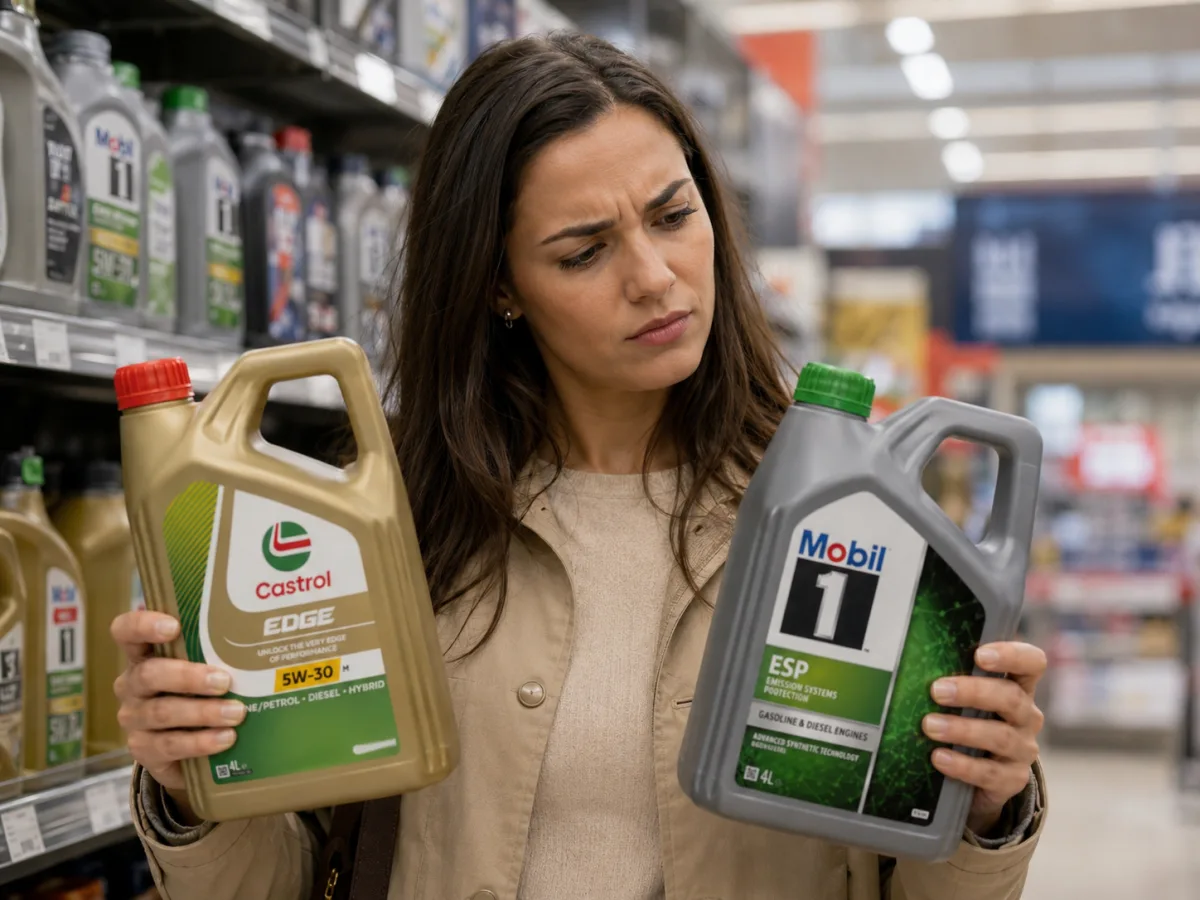
“OEM approved” and “meets requirements” can represent different evidence, but the exact meaning depends on the manufacturer program. A formal approval or license can usually be checked in an OEM list or database. A meets-requirements statement is generally a claim from the oil marketer unless the label also names a verifiable approval or license.
Neither phrase should be turned into a universal warranty promise. First read what the vehicle requires, then verify the exact product and grade through the relevant program.
Watch: Why OEM Approved Oil Matters
Editorial correction: the video simplifies how approvals are earned. OEM programs differ, and approval does not always mean the automaker personally ran every test in its own engine lab. The verifiable program record—not a universal testing story—is what matters.
The direct comparison
| Label or record | What it can establish | What it does not establish by itself |
|---|---|---|
| Product appears in an OEM approved or licensed list | The named product/grade has current program recognition shown by that source | Compatibility with a vehicle that requires a different spec |
| OEM approval or license number on the exact product | A traceable identifier when the program provides one | Approval for every viscosity or sibling product in the brand family |
| “Meets,” “suitable for,” or “recommended for” | The marketer is making a performance or suitability claim | Independent OEM listing unless separately verified |
| API or ACEA category | Compliance or a marketer claim under that system’s rules | Automatic compliance with a vehicle-specific OEM specification |
The correct evidence depends on the wording in the owner’s manual. If it requires a licensed or approved product, a self-declared suitability statement is not the same record.
How real owner’s manuals word the requirement
The wording in your manual tells you which kind of evidence you need:
- GM (approval required): oils meeting the dexos1 specification “are marked with the dexos1 approved logo” (2023 Silverado 1500 manual, p. 340). Look for the logo, not just “meets dexos” wording.
- Ford (specification plus a fallback): “Use oil that meets the defined specification and viscosity grade.” Ford recommends Motorcraft oil and, if it isn’t available, oils of the recommended viscosity that display the API Certification Mark (2022 F-150 manual, p. 572).
- Subaru (approved oil first): “Always use the SUBARU approved engine oil.” If it’s unavailable, the manual lists an alternative oil by API/ILSAC grade and viscosity (2023 Outback manual, pp. 562–563).
Three manuals, three different standards of proof. That’s why you need to read yours before deciding whether a “meets requirements” bottle is enough.
Formal programs use different verification systems
General Motors’ dexos program publishes licensed brands and explains the dexos icon and license number. Volkswagen publishes a technical bulletin listing approved products by VW standard and viscosity. Mercedes-Benz publishes operating-fluid sheets and approved-product lists through BeVo.
Those systems do not justify one universal claim about who ran each test, how much approval costs, how recipes are controlled, or how warranty decisions are made. Use the relevant program’s own record.
ACEA is different again. Its General Requirements state that “claims against the ACEA Oil Sequences can be made on a self-certification basis” (ACEA General Requirements), so the oil marketer stands behind the claim; ACEA itself doesn’t approve individual products. That does not make every ACEA claim unreliable; it means an ACEA claim and an OEM approval are different evidence types.
How to verify the exact bottle
- Find the full oil requirement in the exact-market owner’s manual.
- Record the viscosity, API or ACEA category, and OEM specification separately.
- Check the product’s exact name and viscosity on the label or current data sheet.
- If formal approval or licensing is required, check the OEM’s current list or database.
- Confirm that the listed product and grade match; do not extend approval to a whole brand family.
- Save the source date because approval lists and formulations can change.
Our best engine oil selection guide puts these checks in the correct order.
What this means for warranty questions
Do not promise that one label “fully protects” every warranty or that another label automatically causes denial. Warranty outcomes depend on applicable law, warranty terms, maintenance evidence, failure cause, and market. This article is a product-evidence guide, not legal advice.
The practical maintenance step is to keep receipts, record the exact product and grade, and follow the vehicle’s required specification and interval.
Frequently Asked Questions
Is “meets requirements” oil always bad?
No. It may be a well-supported marketer claim. The point is that it is not automatically the same evidence as appearing in an OEM approval or licensing record.
Does a higher specification number mean better oil?
No. Specification numbers identify different requirements and applications. Use only a substitution the vehicle or specification owner explicitly permits.
What if I already used oil without the required approval?
Record the exact product and amount, check the manual, and ask a qualified service source for the appropriate action. Do not rely on a universal “one change never hurts” rule.
How do I know whether my current oil is approved?
Match the exact product name and grade in the current manufacturer list or licensing database. A similar name or another viscosity is not enough.
Is API certification the same as OEM approval?
No. API certification and OEM programs cover different requirements. A vehicle may require both an API category and a manufacturer specification.
Sources
- Chevrolet, 2023 Silverado 1500 Owner’s Manual, p. 340: dexos1 approved logo. Accessed October 1, 2026.
- Ford, 2022 F-150 Owner’s Manual, p. 572: “use oil that meets the defined specification,” Motorcraft and API Certification Mark fallback. Accessed October 1, 2026.
-
Subaru of America, 2023 Outback Owner’s Manual (MSA5M2304C), pp. 562–563: SUBARU approved engine oil and alternative oil. Accessed October 1, 2026.
- General Motors, About dexos, dexos specification, licensing, icon, license-number, and licensed-brand explanation. Accessed July 27, 2026.
- Volkswagen Group of America, Technical Bulletin 2012855/78: Volkswagen Approved Engine Oils, released April 21, 2025; page 1 scope and approved-product tables by VW standard and viscosity. Accessed July 27, 2026.
- Mercedes-Benz, Operating Fluids (BeVo), current operating-fluid sheets and approved-product lists. Accessed July 27, 2026.
- ACEA, ACEA Oil Sequences 2023—General Requirements, page 3, self-certification and oil-marketer responsibility for ACEA claims. Re-checked October 1, 2026.
- American Petroleum Institute, Motor Oil Guide, API certification marks and service-category guidance. Accessed July 27, 2026.