
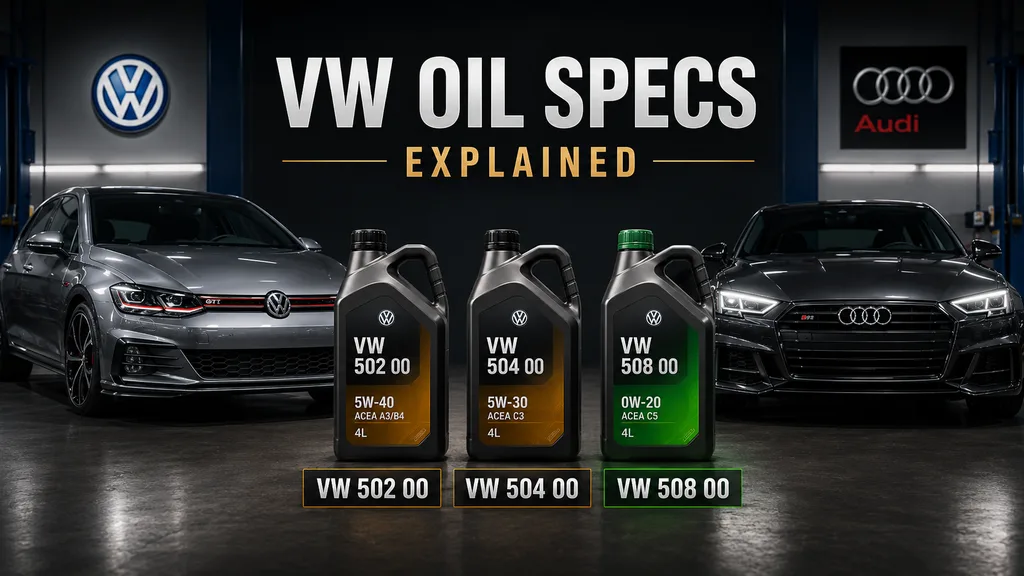
VW 502 00, 504 00, 507 00, and 508 00 are different Volkswagen oil standards—not a “good, better, best” sequence. Use the standard and viscosity named for the exact engine, model year, and US-market vehicle, then choose an exact product on Volkswagen’s current approved-oil list.
Volkswagen Technical Bulletin 2012855/78 makes two limits explicit: its oil list is worldwide, so some products may not be available in North America, and technicians must use Elsa to determine the oil standard for a particular vehicle and engine.
The direct VW oil-selection process
- Identify the complete US vehicle and engine, preferably from the VIN and manufacturer data.
- Find the oil standard and viscosity in the owner’s manual or Volkswagen service information.
- Open the current Volkswagen approved-oil bulletin.
- Find the section for that exact standard.
- Match the product name and viscosity exactly; do not transfer an approval across a product family.
OilFinderPro’s specifications catalog can narrow the search, but legacy pages still under evidence review must be confirmed in current Volkswagen sources.
What viscosities each VW standard covers
We counted every product listed in Volkswagen’s April 2025 approved-oil bulletin by standard and viscosity (VW Technical Bulletin 2012855/78). The pattern is clear:
| VW standard (as listed) | Viscosities of approved products | Listings |
|---|---|---|
| 502 00 / 505 00 | 5W-40 (214), 5W-30 (73), 0W-40 (56), 0W-30 (24) | 367 |
| 504 00 / 507 00 | 5W-30 (210), 0W-30 (114), 0W-20 (1) | 325 |
| 508 00 / 509 00 | 0W-20 only | 183 |
| 511 00 | 5W-40 (17), 0W-40 (2) | 19 |
So VW 502 00 oil is mostly a 5W-40 or 5W-30; 504 00 / 507 00 is a 5W-30 or 0W-30; and 508 00 / 509 00 is always 0W-20 in this list. That’s why the standards aren’t interchangeable: they usually aren’t even the same viscosity.
A real example: Volkswagen’s fluid capacity chart for the 2021 Arteon 2.0L turbo (engine code DLRB) calls for synthetic SAE 0W-30 meeting VW 504 00, 5.7 L (6.0 qt) (VW Arteon fluid capacity bulletin; our spec page).
How to read 502 00, 504 00, 507 00, and 508 00
The standard number is an application requirement. It does not by itself tell you that an oil is suitable for every gasoline or diesel engine in a broad year range.
Volkswagen’s April 2025 bulletin organizes approved products by standard and viscosity. Its tables include, among others:
- VW 502 00 products across specified viscosities;
- VW 504 00 and 507 00 product sections;
- VW 508 00 / 509 00 0W-20 products;
- additional Volkswagen standards for applications outside this comparison.
That supports the existence of distinct approved-product groups. It does not support universal engine mappings, an assumed backward-compatibility rule, or a model-year shortcut.
Why a matching viscosity is not enough
SAE J300 classifies viscosity behavior. A 0W-20 or 5W-40 label does not establish a Volkswagen approval. Two oils with the same grade can carry different manufacturer claims or approvals.
Likewise, API and ACEA labels answer other performance questions. ACEA’s general requirements state that oil marketers are responsible for their claims. If Volkswagen approval is required, verify the exact product in Volkswagen’s current list rather than treating an ACEA category as an automatic substitute.
What not to infer from color, model year, or a higher number
- Do not use oil color as proof of the required VW standard or as a warranty decision rule.
- Do not assume every vehicle from a particular year uses the same standard.
- Do not assume 508 00 replaces 502 00 because the number is larger.
- Do not assume a product approved in one viscosity retains approval in another viscosity.
- Do not import European LongLife intervals into a US vehicle without the applicable US service schedule.
The safest answer to a mixed-year model such as a Tiguan or GTI is not a generic “trap” table. It is exact engine identification plus current Volkswagen service information.
Set the interval separately
The oil standard selects a compatible lubricant. The maintenance schedule or service system sets the change timing. Follow the US owner’s manual for the exact vehicle and any operating-condition provisions it names.
Do not replace that schedule with a universal 5,000–7,500-mile recommendation or a 30,000-kilometer European figure.
Frequently Asked Questions
What is VW 502 00 oil?
An oil approved by Volkswagen to its 502 00 standard. In VW’s current approved list, most 502 00 products are 5W-40, followed by 5W-30, 0W-40 and 0W-30. Use it only where your engine’s manual or Volkswagen service information names 502 00.
Can I use VW 504 00 instead of 502 00?
Only when Volkswagen information for the exact vehicle permits it. Do not infer backward compatibility from the standard numbers.
Can I use 504 00 in a diesel?
Match the exact standard named for the diesel engine. A product or label that combines standards may be listed for particular applications, but that does not make 504 00 alone a universal diesel rule.
Is every VW 508 00 oil green?
Do not use color as the compatibility test. Match the named standard, exact product, and viscosity in Volkswagen’s current list.
Is VW 511 00 the replacement for 508 00?
No universal replacement is established by the number. Use the standard specified for the exact vehicle.
How do I know which VW spec my car needs?
Use the US owner’s manual or Volkswagen service information for the VIN-decoded engine, then verify the exact product in the current approved-oil bulletin.
Sources
- Volkswagen, 2021 Arteon Fluid Capacity Chart (Technical Bulletin): 2.0L Turbo DLRB, VW 504 00, SAE 0W-30, 5.7 L (6.0 qt). Accessed October 1, 2026.
- Volkswagen Group of America, Technical Bulletin 2012855/78: Volkswagen Approved Engine Oils, released April 21, 2025; page 1 scope and Elsa instruction, followed by approved-product tables grouped by VW standard and viscosity (viscosity counts above tallied from this attachment). Accessed October 1, 2026.
- SAE International, SAE J300_202405 Engine Oil Viscosity Classification, Scope, viscosity-classification purpose. Revised May 9, 2024; accessed July 27, 2026.
- ACEA, ACEA Oil Sequences 2023—General Requirements, page 3, oil marketer responsibility and category nomenclature. Accessed July 27, 2026.