
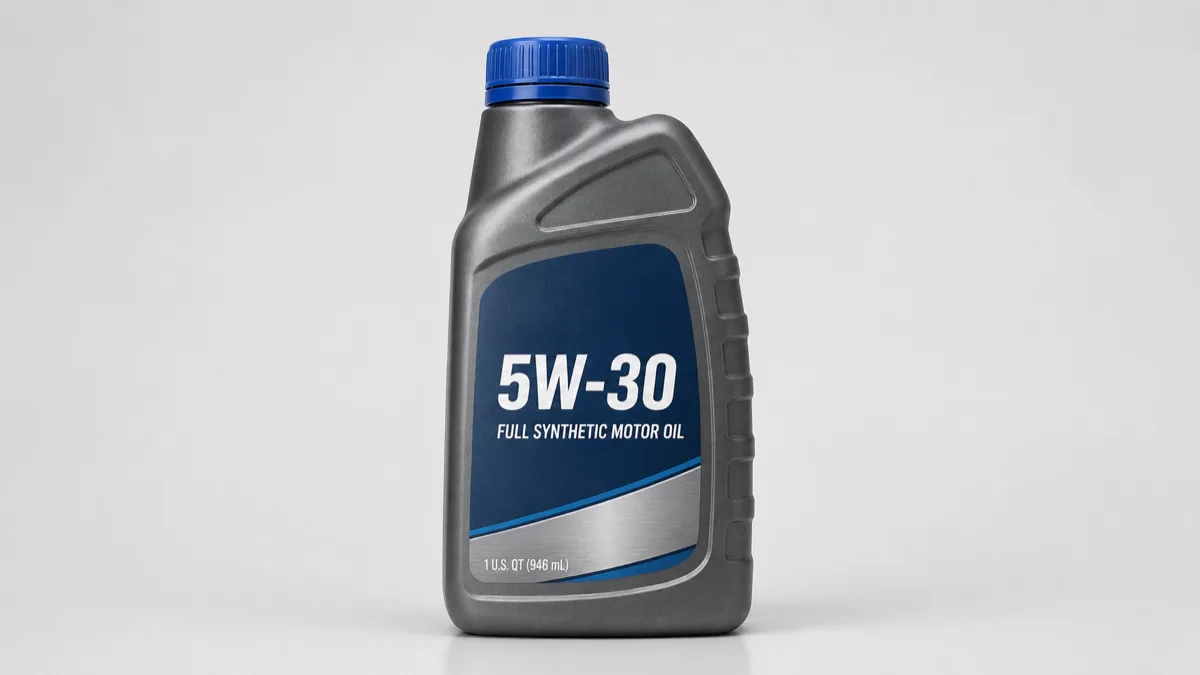
You buy a bottle of oil because the number on the front matches the number on your engine cap. Looks safe enough. Here’s the catch. Two bottles can both say 5W-30 and still be very different oils inside. Put the wrong one in some cars and you can ruin costly parts. On certain diesels, the wrong oil slowly clogs the exhaust filter, and replacing it can run a few thousand dollars.
So what is 5W-30 engine oil? It’s oil that stays thin enough to flow when the engine is cold and thick enough to protect the engine when it’s hot. That’s all the numbers tell you: how the oil flows. But flow is only half the story. The other half is the mix of chemicals in the oil, and that mix has to match what your car was built for. Get it wrong and you can damage the exhaust system, wear out engine parts faster, or lose your warranty.
Not sure which oil your car needs? Download OilFinderPro app.
What Does 5W-30 Actually Mean?
People call the “W” in 5W-30 “weight.” It doesn’t mean weight. It means Winter.
The first part, 5W, is about cold weather. It tells you how well the oil flows when the engine is cold. A lower number flows better in the cold. Picture honey in the fridge next to honey on the counter. Cold oil gets thick and slow, the same way cold honey does. The quicker your oil can move when you start the car on a freezing morning, the sooner it reaches the parts that need it.
The second part, 30, is about heat. Your engine runs hot once it warms up. The 30 tells you the oil stays thick enough to keep a protective layer between the moving metal parts, even when things get hot and you’re working the engine hard, like towing a trailer up a hill.
Why Two Bottles of 5W-30 Can Be Totally Different
Same numbers on the front. Different oil inside. This is the part most people miss, and it’s where the expensive mistakes happen.
Think of shoe size. Two shoes can both be a size 10 and still be nothing alike. One’s a running shoe, one’s a snow boot. The size tells you they fit your foot. It doesn’t tell you they were built for the same job. Oil is the same. The 5W-30 is the size. The chemical mix is what the oil is actually built to do.
Here’s a real one. A lot of modern diesel cars need a low-ash oil so the exhaust filter stays clean. Put in a regular high-ash oil instead, and it burns off a little at a time and leaves ash behind in that filter. The ash builds up and can’t be cleaned out. Eventually the filter clogs, the car drops into a weak “limp” mode, and you’re looking at a new filter for two to four thousand dollars.
The Hidden Strength Rating Almost Nobody Sees
There’s one more thing buried in these oils, and you won’t find it printed on the label. It’s a measure of how well the oil holds its protective film under heavy pressure inside the engine, when everything is hot and working hard.
Carmakers keep asking for thinner oils to save fuel. Thinner oil, slightly better gas mileage. But some engines, especially powerful European ones, need a thicker, stronger film to stay protected.
Put a thin-film oil into an engine that needed the strong stuff, and the film can break down when the engine gets pushed. Then metal rubs on metal. Cam parts wear flat. Rings scrape the cylinder walls. And once again, both bottles said 5W-30.
A Quick Look at the Common 5W-30 Types
Carmakers made up their own oil “approval names” because the basic ratings weren’t strict enough for their engines. Your owner’s manual, or your VIN, tells you which name your car needs. Here are some common ones.
| Approval name | What it’s for | What can go wrong with the wrong oil |
|---|---|---|
| API SP / ILSAC GF-6 | Most newer gas engines (US and Asia) | Engine “knock” that can crack a piston |
| GM dexos1 Gen 3 | Newer GM (Chevy, GMC) gas engines | Turbo damage, warranty denied |
| VW 504 00 / 507 00 | Many VW and Audi engines | Clogged filter, sludge buildup |
| BMW LL-04 | Many BMWs in Europe and the UK | Damaged emissions parts |
| ACEA A3/B4 | Older European and performance cars | Fouled exhaust parts |
Two Real Cars, Two Exact Oils
Take a 2021 Ford F-150 with the 3.5L EcoBoost engine. It’s turbocharged, and engines like this can hit a nasty problem where fuel fires too early and slams the piston hard enough to crack it. The right oil helps stop that. This truck needs a 5W-30 that meets Ford’s own spec, called WSS-M2C961-A1. A random 5W-30 off the shelf won’t cut it.
Now take a 2015 VW Jetta TDI. It’s a diesel, and VW says it has to use an oil that meets a spec called 507 00. That’s a low-ash 5W-30 made to keep the exhaust filter clean. Use a regular 5W-30 and you can wreck that filter in a single oil change.
Can I Use 5W-30 Instead of 0W-20?
You’ll see this argued all over car forums. Some mechanics tell people to switch from the 0W-20 in their manual to a thicker 5W-30. There’s a reason behind it.
Carmakers often pick 0W-20 to help hit fuel-economy rules. Thinner oil, a little better mileage. In hot weather or when towing, a thicker 5W-30 gives a bit more protection, so some mechanics like it for making an engine last longer.
Newer engines are picky, though. A 2017 Honda Civic, for example, uses oil pressure to adjust its own timing while it runs, and it’s tuned around thin 0W-20 oil. A heavier 5W-30 changes how quickly that oil-pressure-actuated system responds, which is one reason automakers ask you to stick with the specified grade. On top of that, if something breaks while you’re running the wrong grade, the dealer can test your oil and use it to deny the repair. When in doubt, use what your manual says.
Does Thicker Oil Help an Old, High-Mileage Engine?
Switching to a thicker oil as a car gets old is a classic move. Most of the time, it’s a band-aid.
Say your engine has 180,000 miles and burns through a quart of oil every thousand miles. That usually means the parts inside are worn or gunked up. Thicker oil won’t fix worn parts. It might slow the oil burning a little, or quiet a noisy engine for a while. You’re covering up the problem, not solving it.
Frequently Asked Questions
Is synthetic 5W-30 the same as regular 5W-30?
No. Both can flow the same way, but synthetic oil is built to handle heat better. When things get really hot, regular oil burns off faster and leaves more gunk behind. Synthetic holds up longer and keeps the engine cleaner. See our guide to synthetic vs. regular oil, explained.
What if I accidentally mix 0W-20 and 5W-30?
Nothing dramatic happens. They blend together somewhere in the middle. Mixing them is far safer than driving with too little oil. If it happens, just book a normal oil change soon and you’re back to normal.
Can I use 5W-30 in my lawn mower?
Usually, yes. Most modern four-stroke mowers run fine on 5W-30, and it makes the mower easier to pull-start when it’s cool out. Check the mower’s manual to be safe, but for most home mowers it’s fine.
How do I know an oil is really “dexos1 Gen 3” approved?
Don’t trust wording like “recommended for” on the back label. Look for the official dexos1 Gen 3 logo printed on the front of the bottle. If it’s not there, the oil hasn’t actually passed GM’s tests.
Will using the wrong oil void my warranty?
It can. If your manual says to use one specific grade and you use something else, the dealer can turn down an engine repair. They really do test the oil from failed engines before paying for a new one.
How do I find the exact 5W-30 my car needs?
Your owner’s manual lists it, but manuals get lost, and one manual often covers lots of versions of the car at once. The fastest way is your VIN. It points to your exact engine and the exact oil the maker approved, so you’re matching the right one instead of guessing.
Download OilFinderPro app. No more guessing at the store.
Sources
- American Petroleum Institute, Motor Oil Guide, API SP and ILSAC GF-6 category definitions and certification marks. Accessed August 11, 2026.
- General Motors, About dexos, dexos1 Gen 3 licensing, logo, and license-number verification. Accessed August 11, 2026.
- Volkswagen Group of America, Technical Bulletin: Volkswagen Approved Engine Oils, 507 00 low-SAPS requirement and approved-product tables. Accessed August 11, 2026.
- Ford Motor Company, WSS-M2C961-A1, SAE 5W-30 gasoline-engine oil specification scope (ILSAC GF-6A / API SP baseline). Accessed August 11, 2026.
- ACEA, ACEA Oil Sequences 2023 for Light-Duty Engines, A3/B4 category definition and scope. Accessed August 11, 2026.
- Q8Oils, The Importance of the BMW LL-04 Specification, BMW Longlife-04 approval scope and viscosity classes. Accessed August 11, 2026.
Read Next
- Synthetic vs. Conventional Engine Oil
- Too Much Oil in Your Car: Symptoms, Risks & What to Do
- API SQ vs. API SP: Changes and Compatibility
- Difference Between 5W-30 and 5W-40 Engine Oil
| *Last Updated: August 2026 | 7-minute read* |