You check the dipstick and the level is down again, but there is no puddle under the car. The oil may be escaping through a hidden external leak, or the engine may be consuming it internally through the crankcase-ventilation system, piston rings, valve-stem seals, or turbocharger oil path. Those routes can produce similar symptoms, so confirm the loss and follow the manufacturer’s test procedure before buying additives or authorizing major engine work.
Direct answer: Check the oil level regularly and keep it within the approved range, but do not treat repeated top-ups as the repair. Look for external leaks first, record consumption over a controlled distance, and use the exact manufacturer limit for the year, model, engine, and market.
Watch: 2-Minute 24-Second Car Is Burning Oil? Video
The video provides a quick overview. Use the sourced diagnostic order below rather than assuming one PCV test or chemical treatment applies to every engine.
Why an Engine Consumes Oil
Several lubricated parts operate next to the intake or combustion path. Oil-control rings manage the film on each cylinder wall, valve-stem seals control oil around the valve guides, the PCV system carries crankcase gases and oil mist back toward the intake, and a turbocharger receives pressurized engine oil. A small amount can pass through these systems and be burned with the fuel; wear, deposits, damaged seals, abnormal crankcase pressure, or a restricted turbo oil drain can increase the rate.
That explains where the oil can go, but it does not identify which part has failed. The driving pattern, measurement method, engine design, service history, and exact manufacturer criteria all matter.
Normal vs. Excessive Oil Consumption
Engines can consume some oil, and the rate changes with load, temperature, break-in, mileage, and engine design. There is no universal “normal” number.
Owner’s manuals say so directly. Toyota notes that “a certain amount of engine oil will be consumed while driving,” and that consumption may increase when the engine is new, with low-quality oil or the wrong viscosity, at high engine speeds or heavy loads, when towing, or with long idling and heavy traffic (2024 RAV4 owner’s manual). Ford says a new engine’s oil consumption reaches its normal level after about 3,000 miles (5,000 km) (2022 F-150 owner’s manual, p. 488).
Manufacturers use different thresholds for specific investigations:
| Manufacturer document | Exact applicability | Decision point in that document |
|---|---|---|
| Ford TSB 20-2132 | 2017–2019 F-150 and 2018–2019 Expedition/Navigator, 3.5L EcoBoost, with listed conditions | One quart in 3,000 miles or less triggers the bulletin’s repair path |
| Hyundai TSB 23-EM-008H | Hyundai gasoline models covered by that inspection procedure | More than 1,000 miles per quart passes; under 1,000 miles per quart advances to the next diagnostic step |
| GM Special Coverage N192287100 | Certain 2012–2013 2.4L Equinox/Terrain vehicles | A quart or more in less than 2,000 miles defines the covered excessive-consumption condition |
These figures conflict because they apply to different vehicles and programs. Do not use one brand’s threshold to judge another engine, and do not assume an old bulletin is current for your VIN.
First Decide: Burning Oil or an External Leak
Oil can disappear from the dipstick without leaving a neat puddle. A valve-cover leak may land on hot exhaust and burn off; an undertray may catch the fluid; a cooler or filter-housing leak may spread while driving.
Before an oil-consumption test:
- inspect the filler cap, filter, drain plug, oil pan, valve covers, cooler, and visible seals;
- note burning smell or smoke from the engine bay;
- clean suspected areas and recheck for the highest fresh wet point;
- repair significant external leaks.
Hyundai’s inspection procedure explicitly tells technicians to resolve large leaks and poor PCV operation before measuring internal consumption. Use the engine-oil-leak guide for that first pass.
| What you notice | Possible route | Why it is not a diagnosis by itself |
|---|---|---|
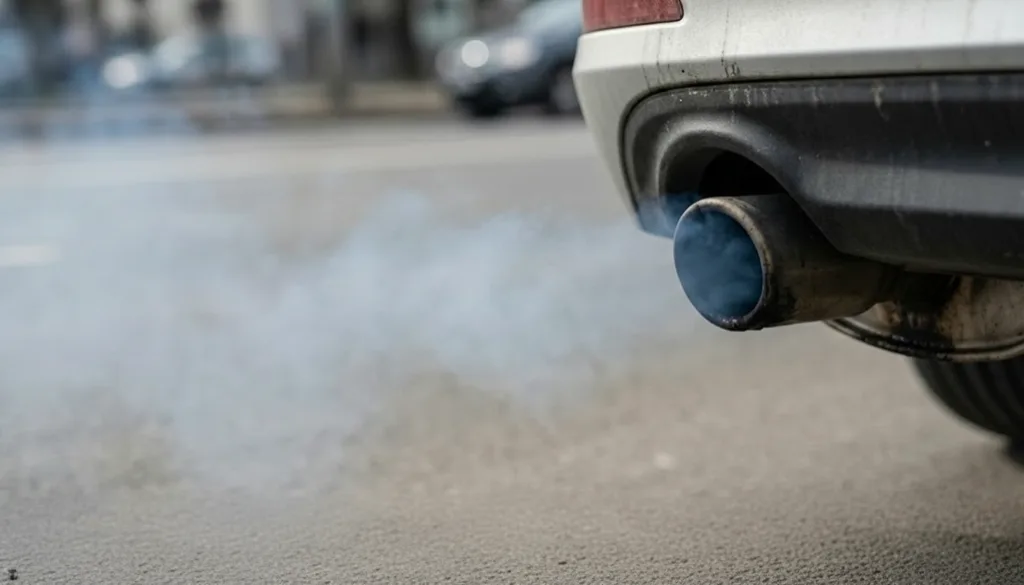
| Brief blue-grey exhaust smoke after startup or deceleration | Valve-stem seals | PCV and turbo faults can produce similar smoke |
| Persistent smoke under load with rising consumption | Rings, cylinder wear, or turbocharger | Compression, leak-down, intake, and turbo checks are still needed |
| Oil in the intake or charge pipes | PCV system or turbocharger | A light film alone does not identify the failed part |
| Smoke or odor from the engine bay | External oil reaching a hot surface | An undertray or airflow can hide the leak from the driveway |
If odor is the main symptom, use the burning-oil-smell guide to separate an internal-consumption clue from oil reaching a hot external surface.
PCV-System Problems
The positive crankcase ventilation system manages blow-by gases and oil mist. A stuck valve, torn diaphragm, blocked passage, or faulty baffle can pull oil into the intake or increase crankcase pressure.
There is no universal “shake the PCV valve” test. Many modern systems integrate valves and diaphragms into a cover. Ford TSB 19-2232, for example, links excessive consumption on specific 3.5L EcoBoost vehicles to a PCV-system concern and directs technicians to replace applicable valve-cover assemblies.
Useful evidence includes oil in intake plumbing, abnormal crankcase vacuum or pressure measured with the correct procedure, relevant fault codes, and an OEM bulletin that matches the VIN and engine.
Piston Rings and Cylinder Wear
Oil-control rings manage the thin lubricating film on the cylinder wall as each piston moves. Deposits can restrict ring movement; worn rings or damaged cylinder walls can leave more oil behind to reach the combustion chamber.
Possible clues include blue-grey smoke under load, low compression, excessive leak-down, oily plugs, and cylinder-wall evidence on a borescope. None proves the diagnosis alone.
Hyundai’s current service procedure includes a controlled consumption test and, for qualifying vehicles, a technician-performed combustion-chamber-cleaning process. It also requires escalation based on results. That is not permission to pour solvent through spark-plug holes at home.
Valve-Stem Seals
Valve-stem seals control oil at the valve guides. Heat and age can reduce their ability to control that oil. A puff of blue-grey smoke after startup or after extended deceleration can be consistent with seal leakage, but PCV and turbo faults can produce similar symptoms.
Confirm with the applicable service procedure before replacing seals. Access and repair scope vary widely by engine.
Turbocharger Oil Leaks
A turbocharger receives pressurized engine oil. Bearing/seal damage, drain restrictions, or crankcase-pressure problems can move oil into the compressor or turbine side.
Oil in charge pipes, smoke after boost, or rising consumption deserves diagnosis of the complete intake, turbo oil feed/drain, and crankcase ventilation system. Replacing the turbo without correcting a blocked drain or PCV fault can repeat the failure.
Do Oil-Burning Additives Work?
Do not treat a bottle as a diagnosis.
- An additive cannot repair worn rings, scored cylinders, a torn PCV diaphragm, failed valve seals, or damaged turbo hardware.
- A manufacturer-approved cleaning procedure may help a specific deposit-related condition, but it can require controlled chemistry, soak time, extraction, an oil change, and follow-up measurement.
- Ford’s manual says not to use supplemental engine oil additives “because they are unnecessary and could lead to engine damage that the vehicle warranty may not cover” (2022 F-150 manual, p. 488).
- A much thicker oil can mask consumption while creating flow, control-system, fuel-economy, or emissions problems.
Use only a treatment specifically authorized for the applicable engine and procedure. Otherwise, spend the money on measurement and diagnosis.
How to Measure Consumption
A repeatable measurement is more useful than estimating from an occasional dipstick reading. Use the interval and level-check procedure specified for the vehicle:
- Repair significant external leaks.
- Change or verify the oil and filter using the exact specification and quantity.
- Run the engine and wait for the manufacturer-specified drain-back period.
- Establish a repeatable full-level reference on level ground.
- Record mileage and secure the service points if the OEM procedure requires it.
- Recheck at the stated distance using the identical measurement method.
- Calculate miles or kilometres per measured quantity added.
- Compare only with the limit for that VIN, engine, market, and current bulletin.
Do not fill above MAX to extend the test; that creates an overfill risk.
When to Visit a Mechanic
Arrange prompt diagnosis when:
- the level reaches MIN before the next normal check;
- consumption is worsening;
- smoke is persistent;
- plugs foul, misfire codes appear, or the catalyst-efficiency light comes on;
- there is turbo noise or oil throughout the intake;
- the engine knocks, rattles, or shows an oil-pressure warning;
- a manufacturer consumption test or bulletin may apply.
GM documented catalytic-converter and oxygen-sensor degradation from excessive oil consumption on a specific 2.4L application. That does not set a universal failure rate, but it shows why continued oil burning can become an emissions-system repair.
Browse OilFinderPro’s available vehicle-specific oil information for the required oil, then confirm consumption limits and diagnostic procedures with the manufacturer or a qualified technician.
Frequently Asked Questions
How can I tell whether my engine is burning oil or leaking it?
Inspect for external leaks first and record the oil level using the same procedure each time. If the level falls without an external source, a documented consumption test and mechanical diagnosis can narrow the cause.
Do oil additives stop an engine from burning oil?
An additive cannot repair worn piston rings, valve-stem seals, or a failed turbocharger. Use only products and procedures the manufacturer allows, and diagnose the cause before relying on a treatment claim.
How much oil consumption is normal?
There is no universal limit. Toyota and Ford both say some consumption is normal, and higher when an engine is new or worked hard. The acceptable test method and threshold can vary by manufacturer, engine, mileage, and operating conditions, so use the service information for the exact vehicle.
Sources
- Ford TSB 20-2132, pages 1–2: applicable 3.5L EcoBoost vehicles, controlled level procedure, and one-quart/3,000-mile decision. Accessed July 26, 2026.
- Ford TSB 19-2232, page 1: specific 3.5L EcoBoost PCV-system oil-consumption condition. Accessed July 26, 2026.
- Hyundai TSB 23-EM-008H, pages 3–5: leak/PCV exclusions, controlled test, and 1,000-mile-per-quart decision. Accessed July 26, 2026.
- General Motors Special Coverage N192287100, pages 1 and 4: applicable 2.4L vehicles, consumption definition, and emissions-component degradation. Accessed July 26, 2026.
- Ford, 2022 F-150 Owner’s Manual, p. 488: new-engine oil consumption note and supplemental-additive warning. Accessed October 1, 2026.
- Toyota, 2024 RAV4 Owner’s Manual (OM42F42U), Engine compartment: engine oil consumption note. Accessed October 1, 2026.