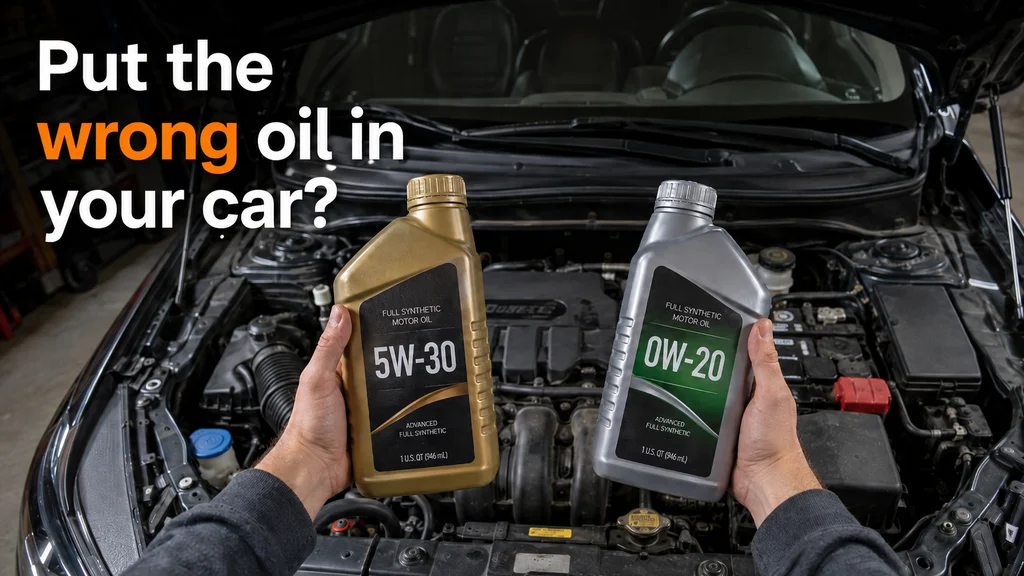
You pull the dipstick, notice the level is low, and grab a leftover jug of motor oil from the garage shelf. After topping up and driving off, you check the bottle’s label and realize you just poured standard mineral oil into a high-performance, turbocharged engine. That knot of panic sets in as you wonder if a simple top-up just ruined your engine.
Putting the wrong oil in your car compromises engine protection, and the consequences range from reduced fuel economy and sluggish timing response to catastrophic thermal breakdown. How bad it gets depends entirely on whether the mismatch is the wrong viscosity, a missing OEM approval, or an incompatible additive chemistry for a modern emissions system.
Not sure which oil your car actually needs? Download OilFinderPro app and find the exact spec by VIN in seconds.
Scenario Quick-Reference Guide
| Mismatch | Primary Mechanical Risk | How Fast It Happens | What To Do Right Now |
|---|---|---|---|
| Wrong viscosity (too thin) | Oil film collapse, bearing wear, localized micro-welding | Bearing wear can start within minutes under heavy load | Critical: change the oil and filter immediately; avoid heavy load until you do |
| Wrong viscosity (too thick) | Oil pump cavitation, cold-start starvation, VVT timing lag, small fuel economy loss | Pressure delay on cold starts; timing codes can appear within days | Monitored: safe to drive short-term, but shorten the oil change interval |
| Wrong certification (API/ACEA) | Soot accumulation, timing chain stretch, timing drift | Wear builds up over a few thousand miles as additives deplete | Monitored: drain and replace with the correct oil at your next stop |
| Wrong OEM spec | Clogged intake valves, turbo bearing wear, oil gallery coking | Gradual efficiency loss; noticeable by mid-life mileage | Monitored: shorten the current interval and refill with the OEM-approved spec |
| Diesel oil in a petrol engine | Excess detergents strip boundary lubrication; ring-seal and compression loss | High friction and blow-by within a few hundred miles | Critical: hot-drain and replace the filter as soon as possible |
| Conventional instead of synthetic | High-temperature breakdown, coking, turbo bearing failure | Turbo bearings can starve within a single hard drive | Critical: get to a shop and plan a full flush |
| Mixing brands or specs | Additive package conflicts, added wear, sludge precipitate | Deposits can clog VVT screens within a few hundred miles | Critical: limit driving, then replace the filter and do a full oil reset |
Wrong Viscosity, Too Thin: The Physics of Oil Film Collapse
Tight-clearance modern engines, like Toyota’s Dynamic Force family, are built around ultra-low-viscosity oils such as 0W-16 or 0W-20. High-performance European platforms from BMW’s M division or Mercedes-AMG mandate much heavier operating weights, typically 5W-30 or 5W-40.
When a low-viscosity oil goes into an engine designed around a heavier one, the hydrodynamic lubrication regime that’s supposed to protect the crankshaft can collapse under peak thermal and mechanical load. Hydrodynamic lubrication relies on the relative motion between a rotating journal and its bearing shell to draw oil into a pressurized wedge, and that wedge is what fully separates the metal surfaces. The thickness of that film is directly tied to the oil’s viscosity at operating temperature.
At high temperature and under the extreme shear rates found inside a running bearing, what actually matters is High-Temperature High-Shear (HTHS) viscosity — how well the oil holds its film once things get hot and moving fast. If HTHS drops below what the engine was designed around, the film collapses, and friction shifts from a full hydrodynamic regime into mixed and boundary lubrication, meaning direct metal-to-metal contact between the crankshaft journal and the bearing shell.
That contact causes localized frictional micro-welding. As the crankshaft keeps rotating, those micro-welds tear apart, producing abrasive wear, bearing spalling, and enough localized heat to spin a bearing shell loose inside its housing. In a worst case, under sustained heavy load, this kind of damage can develop in well under an hour of driving. Ultra-thin oil under extreme heat also volatilizes more readily, which lets more oil vapor slip past valve guides and piston rings — leading to higher oil consumption, carbon buildup, and seal leaks at the turbocharger.
Crankshaft bearing replacement means pulling the engine, machining the crankshaft, and fitting oversized bearings — often a multi-thousand-dollar repair. A damaged turbocharger and its oil lines add another sizable bill on top of that.
Wrong Viscosity, Too Thick: Cold-Start Starvation and VVT Lag
Using a heavier oil, like 15W-40 or 20W-50, in an engine specified for 0W-20 causes a different set of problems: cold-start starvation and hydraulic control lag.
Thick oil thins out more slowly in cold weather — it behaves like cold honey on startup. Pumping a highly viscous fluid takes more effort, and that extra resistance can pull air into the oil pump alongside the oil itself. That’s cavitation. When those air bubbles hit the high-pressure side of the pump, they collapse violently, and the resulting shockwaves pit the pump’s internal surfaces and gears, wearing them down and reducing output pressure over time.
That same flow resistance also delays how quickly the oil galleries pressurize, leaving overhead camshaft journals, lifters, and VVT solenoids running dry under boundary friction right at startup.
Variable valve timing systems rely on quick hydraulic pressure pulses to move the camshaft phasers. Thick oil dampens those pulses, which shows up as timing lag, camshaft correlation fault codes, and a small but real drop in fuel economy.
Oil that’s too thick for the ring package also doesn’t get scraped as cleanly, so more of it burns in the combustion chamber. That leaves metallic ash that permanently clogs particulate filters on both diesel and gasoline direct-injection cars. A clogged particulate filter, a failed VVT phaser, and a worn oil pump are each expensive repairs on their own — and this mismatch can cause all three.
Wrong OEM Spec: Chemistry and Emissions Aftertreatment
Viscosity is only half the story. Manufacturers publish their own proprietary oil specifications with strict chemical additive limits, and a generic oil rarely satisfies all of them even when the viscosity grade matches. For a deeper walkthrough of how those approval codes actually work, see our guide to matching an OEM-approved diesel oil spec exactly.
Volkswagen’s 507 00 spec, for example, requires a low-ash (“Low-SAPS”) chemistry to protect the diesel particulate filter, while its 505 01 spec is built to protect high cam loads on older pump-injector diesels — our breakdown of VW’s 502 00, 504 00, and 508 00 specs covers how these differ in practice. Pour a high-ash oil in where a low-SAPS oil belongs and it clogs the filter with metallic ash over time. Soot burns off during active regeneration at high exhaust temperatures, but metallic ash never does — it just accumulates.
On turbocharged direct-injection engines, using an older API SN-category oil instead of the newer API SP or API SQ can contribute to Low-Speed Pre-Ignition (LSPI), where a fuel-oil droplet ignites spontaneously before the spark plug fires, usually at low RPM under high load. See our comparison of API SQ and API SP for what changed between the categories and why it matters. Older-style detergent packages can make pre-ignition worse, and a severe pre-ignition event (“superknock”) can break a piston or bend a connecting rod outright. Soot from direct injection also grinds inside timing chain links over time; the dispersants in the newer API categories are specifically formulated to reduce that wear.
How Long Can You Drive on the Wrong Oil?
Whether it’s safe to keep driving or you need to shut the engine down right away depends entirely on which mismatch you’re dealing with.
The Monitored Tier (Low to Moderate Risk)
This covers minor viscosity mismatches — say, 5W-40 instead of 5W-30 — or running a quality synthetic in place of an OEM-branded fluid. A backward-compatible API category (a newer SP oil in an engine that specifies SN, for instance) is generally fine.
Symptoms are subtle: slightly slower cold-start cranking, a small drop in fuel economy, or minor VVT timing lag. It’s safe to keep driving, but correct the oil at your next convenient service or shorten the current interval.
The Critical Tier (Extreme Danger)
This covers running a low-HTHS, fuel-economy-focused oil like 0W-16 in a high-load European engine, mineral oil in a turbocharged car, or any unapproved oil in an engine with a wet timing belt.
Watch for an oil pressure warning light that flickers or stays lit, loud metallic ticking or tapping from the top of the engine, thick blue-grey exhaust smoke under load, or an acrid, burning-oil smell. If you see any of these, don’t start or keep driving the car — shut it off and have it towed to a shop. Continuing to drive on a compromised oil film is how a bearing seizes, and that’s a repair measured in thousands of dollars, not hundreds.
What To Do Right Now: A Recovery Protocol
If you’ve already used the wrong oil, acting quickly limits the wear.
1. Perform a hot drain. Drain the oil while it’s still hot, on level ground, and give it a full 15–20 minutes. Draining hot keeps wear metals and soot suspended so they actually leave with the oil instead of settling in the pan.
2. Replace the filter — never reuse it. A used filter can hold close to a quart of the wrong oil, and that instantly dilutes and contaminates the fresh fill.
3. Consider a sacrificial flush for serious mismatches. A single drain typically leaves a meaningful amount of the wrong oil behind in the galleries. For anything in the critical tier, refill with the correct oil and filter, drive a short distance, then drain hot and refill again with fresh oil and a fresh filter.
Skip chemical flush additives. They strip the protective oil film from cylinder walls, which causes startup wear, they can degrade rubber gaskets and seals and cause leaks, and they can loosen debris that clogs the oil pump screen or turbo feed line — starving the engine of oil rather than protecting it.
Dealer vs. Independent Shop
Standard oil-and-filter service is fine at any competent independent shop. But cars with a wet timing or oil-pump belt running inside the engine — Ford’s 1.0L and 1.5L EcoBoost three-cylinders and Stellantis/PSA’s 1.2L PureTech among them — need a shop experienced with that specific design. Our guide to matching the exact oil spec for Ford engines covers how to find the correct WSS-approved oil for these platforms. These belts run bathed in oil, and incompatible additives can cause the rubber to swell, crack, and shed fibers into the sump. Those fibers block the oil pickup screen, starving the pump — so on these engines, the pan needs to come off, the strainer needs a look, and the belt itself should be inspected, not just the oil changed.
Will the Wrong Oil Void Your Warranty?
Using an oil the manufacturer hasn’t approved can void your powertrain warranty. If a covered component fails, manufacturers can pull an oil sample and test it before approving a claim.
Warranty labs typically run two kinds of tests: ICP spectrometry, which measures anti-wear elements like zinc and phosphorus in parts per million (if a low-SAPS spec was required but the sample shows high metal content, the claim gets rejected), and gas chromatography or shear-stability testing, which checks whether the actual base oil and viscosity match what the engine calls for.
If a third-party shop or quick-lube service did the work, protect yourself with a clear paper trail: make sure the invoice lists the exact brand, viscosity, and OEM approval used — a vague “5W-30 full synthetic” line item doesn’t help you — and photograph the bottles or bulk-drum labels at the time of service, focusing on the approval block on the back. Our guide to reading OEM-approved vs. “meets requirements” labeling explains exactly what to look for on that label.
Frequently Asked Questions
Can I use 5W-30 instead of 0W-20?
Not as a regular practice. Tight-clearance engines with VVT systems are tuned around the exact oil pressure a lighter oil provides. A thicker oil raises resistance and can slow timing response, along with a small fuel economy penalty. In an emergency, running 5W-30 briefly beats running low, but switch back at your next service. Our full 5W-30 explainer covers how these viscosity grades actually differ and when it’s safe to swap between them.
What happens if a mechanic puts the wrong oil in my car?
Check your service invoice against your owner’s manual as soon as you notice. If the listed spec doesn’t match what your car requires, ask the shop to redo the oil and filter change at their expense — most reputable shops will.
Does the wrong engine oil cause the oil pressure warning light to come on?
Yes. An oil that’s too thin can let pressure drop below the safe threshold under load, while an oil that’s too thick causes pump cavitation and can trigger warnings right at startup.
Will mixing conventional and synthetic oil ruin my engine?
Not immediately — they blend without dramatic reaction — but it shouldn’t become a habit. Different base stocks and additive packages don’t always play well together, and mixing can raise wear rates and encourage sludge. Our full guide to mixing engine oils covers which combinations are actually safe. Keep any mixed-oil driving short and follow up with a full drain and refill.
Can I keep driving my car with the wrong oil grade?
It depends on the mismatch. A minor viscosity difference is generally safe for a normal interval. A wrong OEM spec or high-ash oil in a diesel with a particulate filter is not — get that drained and replaced as soon as you reasonably can.
How does a manufacturer prove the wrong oil caused a failure?
Through lab testing — ICP spectrometry and gas chromatography on an oil sample pulled from the failed engine. If the chemistry or viscosity doesn’t match the approved spec, the warranty claim is denied.
Protect Your Engine with VIN-Based Precision
Don’t guess at the parts store shelf. A single wrong bottle can mean a multi-thousand-dollar repair and a voided warranty. Use our free, VIN-based lookup to find the exact OEM-approved oil — and the right filter — for your specific engine.
Download OilFinderPro app. No more guessing at the store.
Sources
- American Petroleum Institute, Motor Oil Guide, API SN, SP, and SQ category definitions and LSPI protection requirements. Accessed August 25, 2026.
- ACEA, ACEA Oil Sequences 2023 for Light-Duty Engines, Low-SAPS category scope and ash-limit definitions. Accessed August 25, 2026.
- Volkswagen Group of America, Technical Bulletin: Volkswagen Approved Engine Oils, 507 00 and 505 01 specification scope. Accessed August 25, 2026.
- Ford Motor Company, WSS-M2C961-A1, SAE 5W-30 gasoline-engine oil specification scope. Accessed August 25, 2026.
- General Motors, About dexos, dexos licensing and approval verification. Accessed August 25, 2026.
- STLE, Society of Tribologists and Lubrication Engineers — Tribology Basics, hydrodynamic lubrication and boundary-friction fundamentals referenced for the bearing-wear mechanism. Accessed August 25, 2026.
Read Next
- Synthetic vs. Conventional Engine Oil
- Mixing Engine Oils: What Is Safe and What Is Not
- API SQ vs. API SP: Changes and Compatibility
| *Last Updated: August 25, 2026 | 10-minute read* |