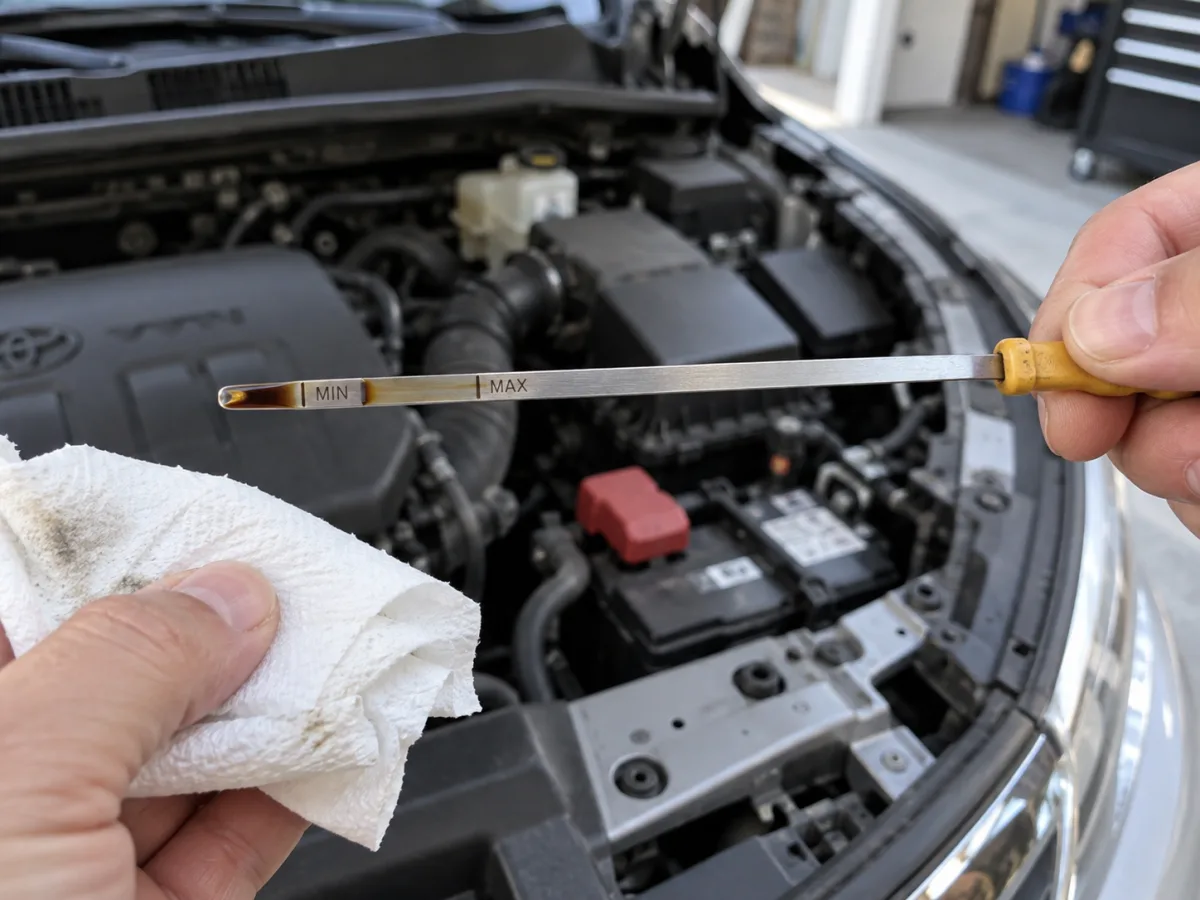
To check engine oil, park on level ground, switch the engine off, wait for the time your manual gives, then pull the dipstick, wipe it, reinsert it fully and pull it out again to read the level. It should sit between the low mark and the upper mark. Toyota’s version, for example: warm up the engine, turn it off, wait about 5 minutes, and check that the level is above the low mark (2024 RAV4 owner’s manual, Engine compartment).
Topping up? Use the right oil: look up your vehicle’s spec.
When to check: hot or cold?
Manufacturers don’t agree, so use your own manual’s timing:
| Manual | When to check |
|---|---|
| Toyota (2024 RAV4) | Engine warmed up and turned off, then wait about 5 minutes |
| Ford (2022 F-150) | Before starting, or switch off after warming up and wait 10 minutes |
| Chevrolet (2021 Express) | Most accurate cold, after at least two hours off; otherwise at least 15 minutes if warm or 30 minutes if not warm |
Sources: RAV4 manual; F-150 manual, p. 488; Express manual, p. 184.
What they all agree on: don’t read the dipstick right after shutting the engine off. Oil is still draining back to the pan, so the level looks falsely low, and topping up a falsely low reading is how engines get overfilled. For more, see should you check oil hot or cold.
How to check engine oil, step by step
- Park on level ground and switch the engine off.
- Wait for the time your manual specifies (see the table above).
- Pull out the dipstick while holding a rag under the end, and wipe it clean.
- Reinsert it fully until it seats.
- Pull it out again and read where the oil film ends.
- Compare with the marks. The level should be between the low mark and the upper mark. Toyota notes that “the shape of the dipstick may differ depending on the type of vehicle or engine.”
- Reinstall the dipstick fully when you’re done.
How much oil is between the marks?
More than people assume, and it varies. In the 2024 RAV4, the gap between the low level mark and the refill upper limit mark is 1.6 qt (1.5 L) (RAV4 manual). So the popular “one quart from MIN to MAX” rule of thumb doesn’t hold for every engine. Add oil slowly, checking the dipstick as you go, as Toyota instructs, rather than pouring in a fixed amount.
Never go above the upper mark. Ford warns that “oil levels above the maximum mark may cause engine damage” (F-150 manual, p. 488). If you’ve already overfilled, see too much oil in the engine.
No dipstick? Electronic oil level checks
Some cars measure the level electronically and show it on a screen. The 2022 GR Supra is an example: the level appears under “My Vehicle” › “Vehicle status” › “Engine oil level,” and a current measured value is available after about 30 minutes of normal driving (GR Supra owner’s manual, Operating materials). Menu paths differ by brand and model, so follow the instructions in your own manual.
How often to check your engine oil
Toyota simply says to check the oil level “on a regular basis,” and explains that every engine uses some oil between changes (RAV4 manual). It lists situations where consumption may increase:
- when the engine is new;
- with low-quality oil or oil of the wrong viscosity;
- at high engine speeds, with heavy loads or towing, or with frequent hard acceleration and braking;
- with long idling or frequent heavy traffic.
Ford adds that a new engine’s oil consumption reaches its normal level after about 3,000 miles (5,000 km) (F-150 manual, p. 488). Checking at regular fuel stops and before long trips catches a change early. If the level keeps dropping, see why a car burns oil.
Can the oil level go up?
Yes. Toyota explains that if the car is repeatedly driven without the engine warming up, moisture from condensation or unburned fuel can mix into the oil and raise the level, and that this “is not a malfunction” (RAV4 manual). A level that keeps rising, or oil that looks milky, still deserves a check; see what engine oil color tells you.
Common mistakes
- Checking on a slope. Every manual cited here starts with level ground.
- Reading too soon after shutdown. The oil hasn’t drained back yet, so the reading is low.
- Adding oil to a hot engine. Ford warns not to add engine oil when the engine is hot, and never to remove the filler cap with the engine running (F-150 manual, p. 488).
- Pouring in a full quart by default. The space between the marks varies; add a little and recheck.
Frequently asked questions
How do you check engine oil?
Park on level ground, switch the engine off and wait as your manual says. Then pull the dipstick, wipe it, reinsert it fully and pull it out to read the level between the low and upper marks.
Should you check oil hot or cold?
Follow your manual. Toyota checks a warmed-up engine after about 5 minutes; Ford allows a check before starting or 10 minutes after a warm shutdown; Chevrolet’s Express manual prefers a cold check after two hours.
How much oil is between the min and max marks?
It depends on the engine. In the 2024 RAV4 it’s 1.6 qt (1.5 L), so don’t assume one quart.
Does the check engine light mean low oil?
No. The check engine light reports emission and powertrain faults; low oil pressure has its own red warning light. See check engine light after an oil change.
Sources
- Toyota, 2024 RAV4 Owner’s Manual (OM42F42U), Engine compartment: checking the engine oil, 1.6 qt between the low level mark and refill upper limit mark, adding oil, consumption and level-rise notes. Accessed October 1, 2026.
- Ford, 2022 F-150 Owner’s Manual, p. 488: checking the engine oil level, maximum-mark warning, hot-engine and filler-cap warnings, new-engine oil consumption. Accessed October 1, 2026.
- Chevrolet, 2021 Express Owner’s Manual, p. 184: checking engine oil, cold-check accuracy and wait times. Accessed October 1, 2026.
- Toyota, 2022 GR Supra Owner’s Manual (OM9A056U), Operating materials: electronic oil level display and measurement. Accessed October 1, 2026.