
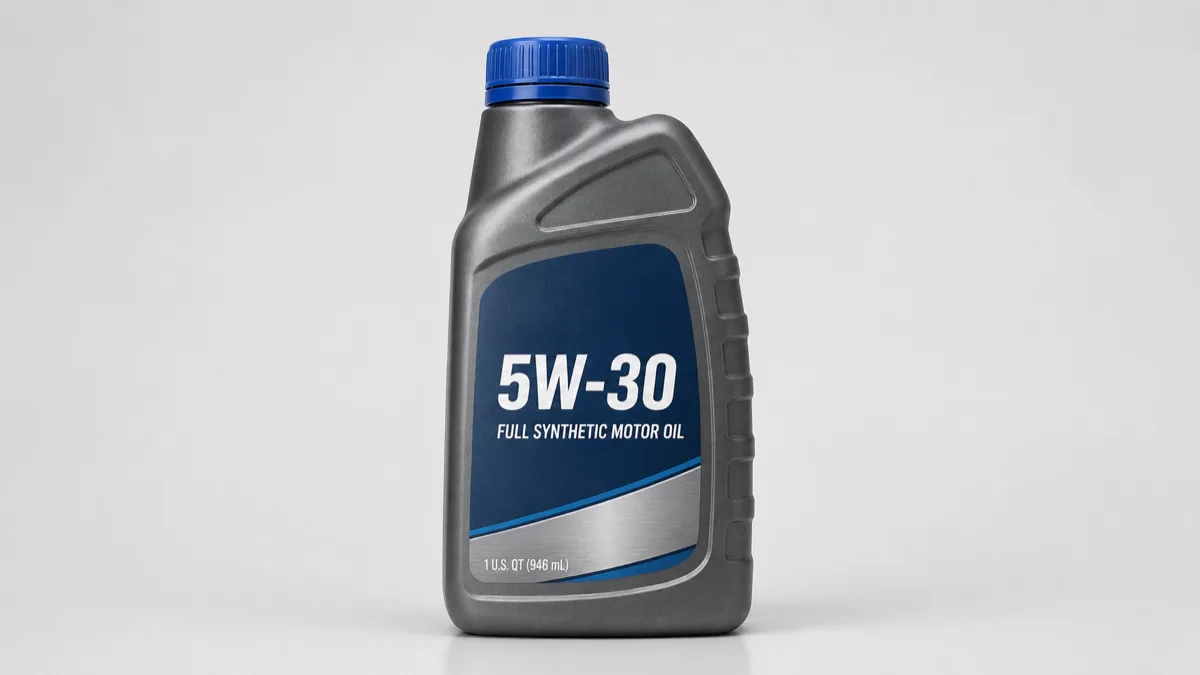
5W-30 and 10W-30 are the same thickness once the engine is warm; the difference is cold starting. Both are “30” grades at operating temperature, but a 5W oil must pass its cold tests 5 °C colder than a 10W oil. Use the grade your owner’s manual specifies. Some manuals list both, choosing by outside temperature.
Not sure which grade your engine takes? Look up your vehicle.
5W-30 vs 10W-30 in SAE J300 terms
| SAE J300 limit | 5W-30 | 10W-30 |
|---|---|---|
| Cold cranking (max) | 6,600 mPa·s at −30 °C | 7,000 mPa·s at −25 °C |
| Cold pumping (max) | 60,000 mPa·s at −35 °C | 60,000 mPa·s at −30 °C |
| Kinematic viscosity at 100 °C | 9.3 to <12.5 cSt | 9.3 to <12.5 cSt |
| HTHS at 150 °C (min) | 2.9 mPa·s | 2.9 mPa·s |
Source: SAE J300 engine oil viscosity classification. The hot half is identical; only the cold half differs. In practice, 5W-30 flows more easily on a cold start, which matters most in winter.
Real engines that use 10W-30, and what they switch to in the cold
10W-30 is now uncommon in passenger cars but still appears in heavy-duty diesel pickups. Both examples below switch to a lower “W” grade in extreme cold, which is exactly the 5W-vs-10W difference at work:
| Engine (owner’s manual) | Normal grade | Cold-weather grade |
|---|---|---|
| 2023 Ford Super Duty 6.7L Power Stroke diesel | SAE 10W-30, Ford WSS-M2C171-F1 | SAE 0W-40 at −22 °F / −30 °C or below |
| 2023 Ram 2500/3500 6.7L Cummins diesel | SAE 10W-30 above 0 °F, MS-10902, API CK-4 | SAE 5W-40 synthetic below 0 °F (−18 °C) |
Sources: 2023 Super Duty owner’s manual, pp. 526–528; 2023 Ram 2500/3500 owner’s manual, p. 402. Spec pages: F-250 6.7L, Ram 3500 Cummins.
For comparison, gasoline engines in the same class commonly specify 5W-30. The 2022 F-150 3.5L EcoBoost, for example, calls for SAE 5W-30 meeting WSS-M2C961-A1 (2022 F-150 manual, pp. 572–573). Among the vehicles we’ve checked against their manuals:
Can I use 5W-30 instead of 10W-30?
Only if your manual lists it. Many manuals pick the grade by outside temperature, as the Ford and Ram diesels above do, so the same engine may call for a lower “W” grade in winter. If your manual names only 10W-30 together with a specific approval (like Ford WSS-M2C171-F1 or FCA MS-10902), the approval matters as much as the grade. A 5W-30 without it isn’t a match.
Can I use 10W-30 instead of 5W-30?
Only if your manual allows it. 10W-30 is thicker on a cold start, so in an engine specified for 5W-30, especially in cold weather, it’s not an equivalent. In a 5W-30 gasoline engine with its own manufacturer specification (Ford, GM dexos1, FCA), a 10W-30 is also unlikely to carry that approval.
Can you mix 5W-30 and 10W-30?
As an emergency top-up, mixing two grades leaves you with an oil somewhere between them and no defined SAE grade. Treat it as temporary and return to your manual’s grade at the next oil change. See can you mix synthetic and conventional oil for what manufacturers allow.
Frequently asked questions
What is the difference between 5W-30 and 10W-30?
The cold rating. Under SAE J300, 5W is tested at −30 °C (cranking) and −35 °C (pumping); 10W at −25 °C and −30 °C. Both have the same 30-grade viscosity at operating temperature.
Is 5W-30 better than 10W-30?
Only for cold starts. Neither is “better” in general; use the grade, and any manufacturer specification, your owner’s manual names.
Which is thicker, 5W-30 or 10W-30?
10W-30 is thicker when cold. At operating temperature they fall in the same 9.3 to under 12.5 cSt range.
Sources
- SAE International, J300 Engine Oil Viscosity Classification (APR2021): 5W and 10W cold limits, 30-grade kinematic and HTHS limits; values checked against published reproductions of the table. Accessed October 1, 2026.
- Ford, 2023 Super Duty Owner’s Manual, pp. 526–528: 6.7L diesel SAE 10W-30 WSS-M2C171-F1; SAE 0W-40 for extremely cold climates. Accessed October 1, 2026.
- Ram, 2023 2500/3500 Owner’s Manual, p. 402: 6.7L diesel 10W-30 above 0 °F, 5W-40 synthetic below 0 °F, MS-10902, API CK-4. Accessed October 1, 2026.
- Ford, 2022 F-150 Owner’s Manual, pp. 572–573: SAE 5W-30 WSS-M2C961-A1. Accessed October 1, 2026.